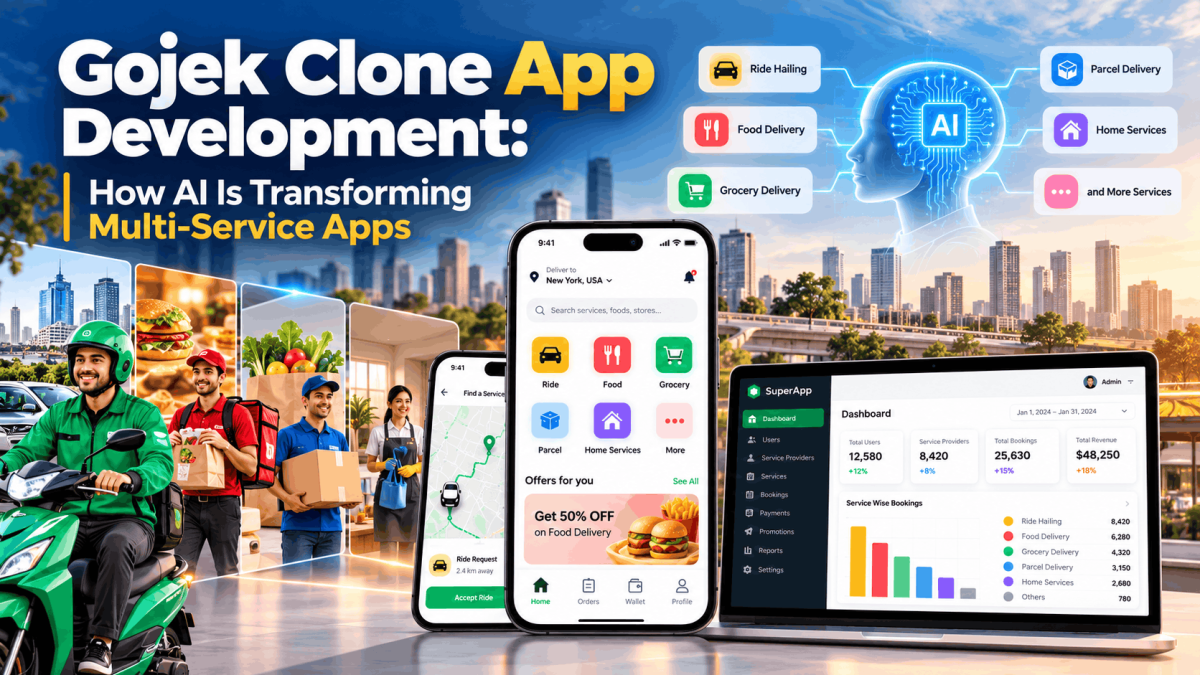
Gojek Clone App Development: How AI Is Transforming Multi-Service Apps
-
Ankit Patel
- October 22, 2026
- 8 min read
Customers increasingly expect digital platforms to handle multiple everyday needs through a single application. From booking rides and ordering food to purchasing groceries, sending parcels, and hiring professionals, convenience has become a major part of the digital service experience.
This shift has created opportunities for entrepreneurs looking to build multi-service platforms inspired by successful super-app business models. However, launching an application with multiple services is no longer enough to stand out. Businesses must also consider personalization, operational efficiency, automation, and intelligent customer experiences.
This is where Gojek clone app development combined with artificial intelligence (AI) becomes an interesting opportunity. By integrating AI into a multi-service platform, businesses can introduce smarter recommendations, improve service matching, forecast demand, automate customer support, and make better use of operational data.
For startups and established businesses, the goal is not simply to reproduce an existing business model. It is to develop a distinctive platform that addresses customer needs and creates long-term business value.
What Is Gojek Clone App Development?
Gojek clone app development refers to building a multi-service application inspired by the super-app model, where customers can access several services through a unified digital platform.
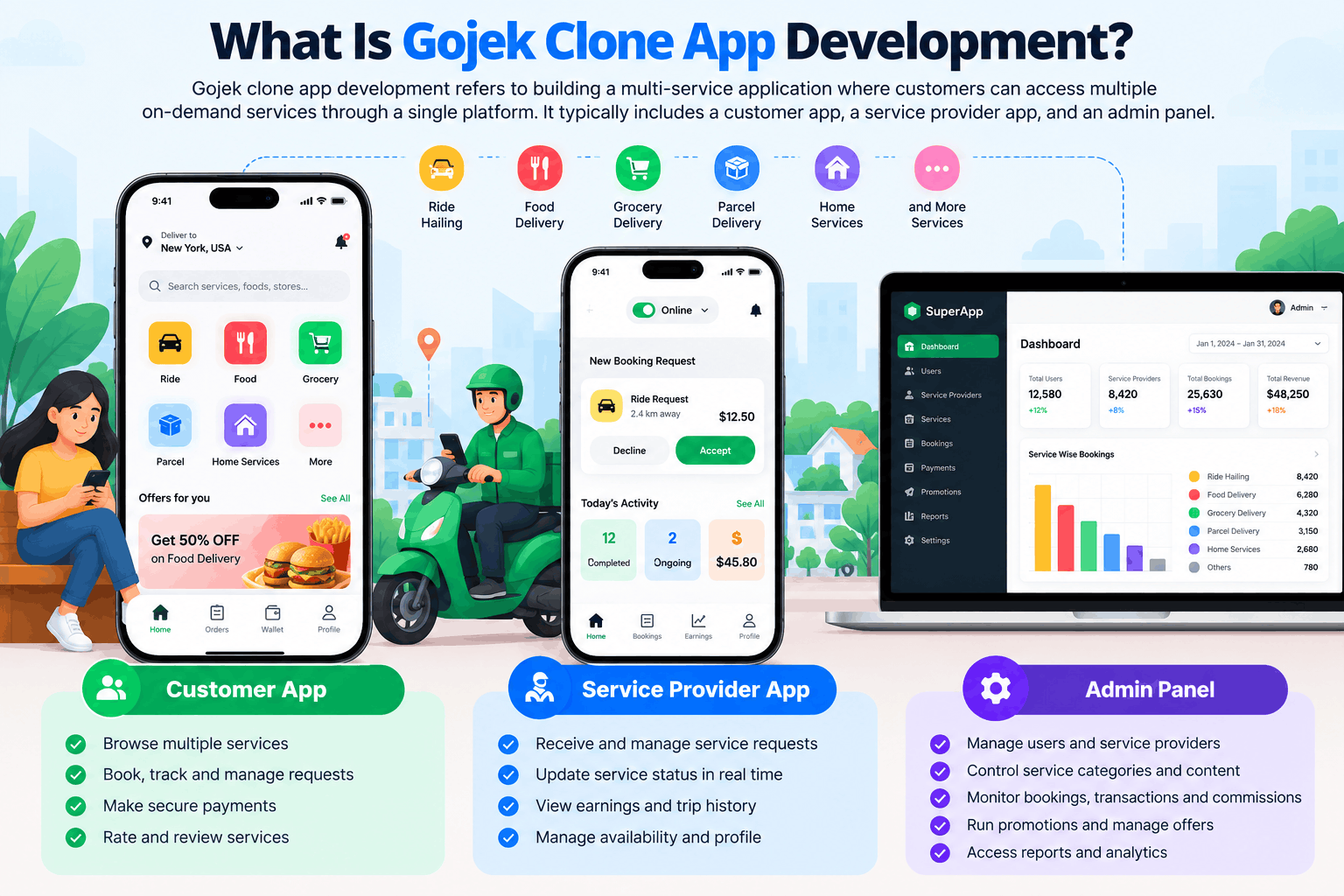
Depending on the business strategy, the application may include ride-hailing, food delivery, grocery shopping, parcel delivery, home services, and other on-demand offerings.
A typical platform consists of three primary interfaces:
- Customer app: Allows users to browse services, make bookings, track requests, pay, and submit reviews.
- Service provider app: Enables drivers, delivery partners, merchants, and professionals to manage requests and update service status.
- Admin panel: Gives the business control over users, providers, transactions, commissions, service categories, promotions, and reporting.
The precise features depend on the target market and business model. A startup may begin with two or three services and introduce additional categories after establishing demand.
Gojek’s official website describes its platform as a multi-service ecosystem covering areas such as transportation, food and goods delivery, and other everyday services. This demonstrates the breadth of the super-app concept without implying that a new platform needs to duplicate Gojek’s branding or proprietary technology. Source: Gojek.
Why AI Is Changing Multi-Service App Development
Traditional on-demand applications primarily process bookings, payments, service assignments, and notifications. AI introduces opportunities to make these processes more adaptive and data-driven.
For example, a platform can analyze previous bookings to identify busy periods, recommend relevant services based on customer preferences, or help match a request with an available provider.
The wider adoption of AI is also influencing customer expectations. According to DHL’s 2025 online shopper research, 38% of global shoppers had used AI-powered chat tools or virtual assistants to browse or buy online. This finding concerns online shopping behavior rather than all on-demand app users, but it illustrates how AI-assisted experiences are becoming part of digital commerce. Source: DHL eCommerce.
For businesses investing in Gojek clone app development, the opportunity is to apply relevant AI capabilities to genuine customer and operational challenges rather than adding technology simply to follow a trend.
How AI Can Improve a Multi-Service Application
1. Personalized Service Recommendations
Customers using a multi-service platform may have different needs depending on their location, preferences, previous activity, and time of day.
AI-powered recommendation systems can analyze relevant interaction data to suggest services, merchants, products, or offers that are more useful to individual users.
For instance, a customer who frequently orders groceries might receive relevant shopping suggestions, while someone who regularly books transportation may see convenient ride options.
Personalization should remain transparent and respectful of user privacy. Businesses should collect only the information they need and provide appropriate controls over how customer data is used.
2. Intelligent Service Matching
Matching customers with suitable service providers is a core function of many on-demand platforms.
AI can help evaluate factors such as location, provider availability, service category, estimated response time, ratings, and previous performance. This can support more relevant assignments and improve resource utilization.
For a home-service platform, the system might prioritize professionals with the required skills and availability. For ride-hailing, it could help identify suitable drivers based on location and estimated pickup time.
The results depend on data quality, platform design, and the reliability of the matching logic.
3. Demand Forecasting and Resource Planning
Demand rarely remains constant throughout the day. It can fluctuate by location, season, weather, local events, and customer behavior.
AI-based forecasting can analyze historical bookings and relevant real-time signals to estimate when and where demand may increase.
Businesses can use these insights to plan provider availability, delivery capacity, promotional campaigns, and customer support resources.
The OECD’s February 2026 report on AI in mobility identifies demand forecasting, route optimization, and predictive maintenance among the important applications of AI in transportation. These use cases are particularly relevant to multi-service platforms that manage rides, deliveries, or fleets. Source: OECD, Progress in Implementing the European Union Coordinated Plan on Artificial Intelligence, Volume 2.
4. AI Chatbots and Customer Support
Customers frequently contact support teams about booking confirmations, delivery delays, cancellations, payments, refunds, and account issues.
AI chatbots can handle common questions, provide status updates, and guide users through routine processes. More complicated or sensitive cases should be escalated to human support staff.
A well-designed support system can combine automation with human assistance instead of forcing every customer through a chatbot.
5. Smarter Routes and Delivery Management
Transportation and delivery services depend on timely assignments and efficient routes.
AI-supported systems can analyze traffic conditions, delivery locations, travel patterns, and operational constraints to recommend route adjustments. They can also help estimate arrival times and identify potential disruptions.
These capabilities are particularly valuable for platforms that combine ride-hailing, parcel delivery, food delivery, and grocery services.
Key Features to Consider When Building an AI-Powered Gojek Clone App
An AI-powered Gojek clone app can include several intelligent features, but the right selection depends on the business’s target audience and service categories.
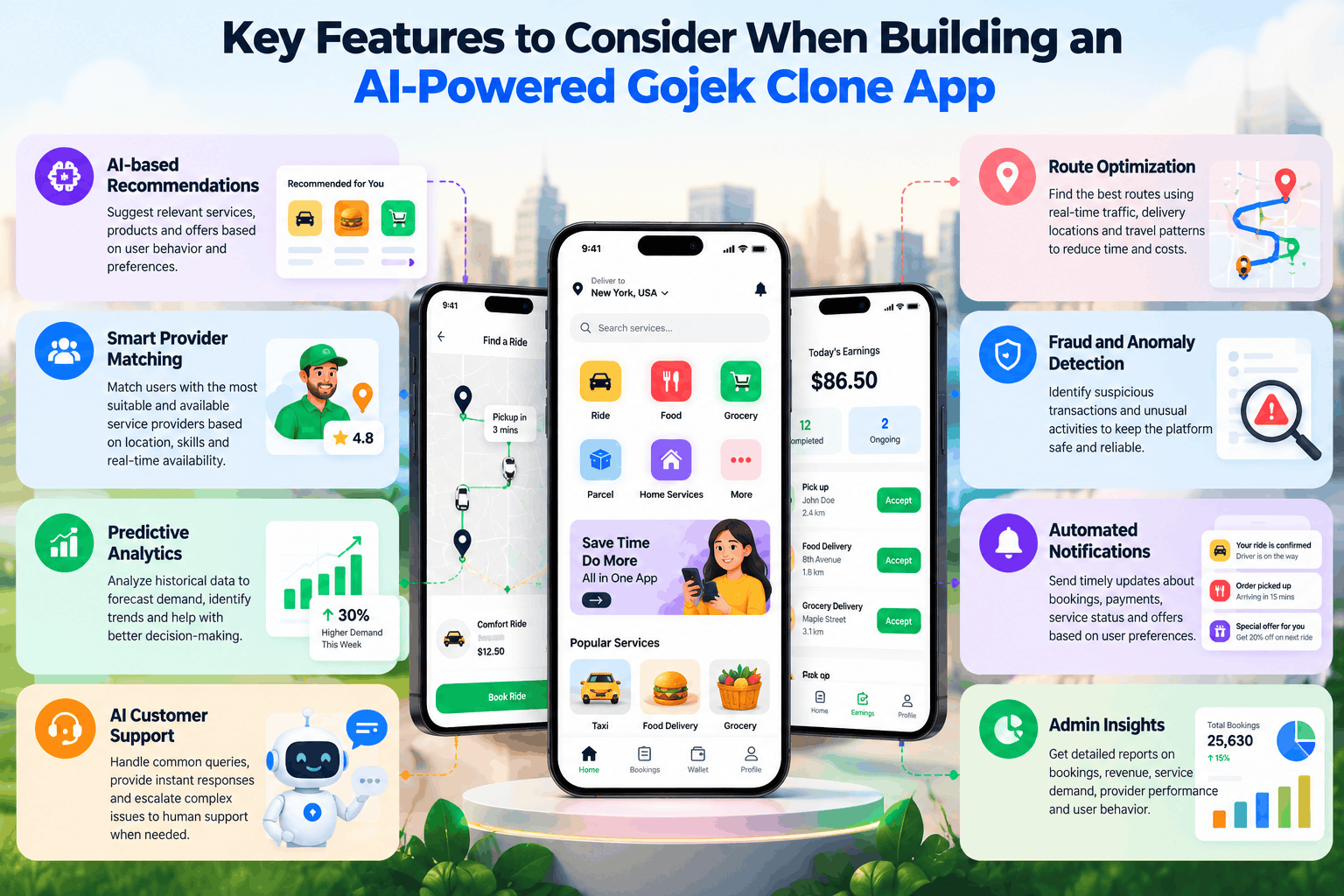
Useful options include:
- AI-based recommendations: Suggest relevant services, products, and offers.
- Smart provider matching: Match requests with suitable available providers.
- Predictive analytics: Identify booking patterns and operational trends.
- AI customer support: Answer common questions and assist with routine requests.
- Route optimization: Support efficient delivery and transportation planning.
- Fraud and anomaly detection: Flag suspicious transactions or unusual activity for further review.
- Automated notifications: Send relevant updates based on booking status and user preferences.
- Admin insights: Summarize performance trends, cancellations, service demand, and provider activity.
These features do not all need to be launched together. A business can begin with the capabilities most likely to improve its core service and expand after measuring the results.
Industries That Can Benefit From AI-Powered Multi-Service Apps
The multi-service model can support several business categories, depending on local demand and operational requirements.
1. Transportation and ride-hailing: Intelligent driver matching, estimated arrival times, and demand forecasting.
2. Food and grocery delivery: Personalized product recommendations, order predictions, delivery planning, and automated support.
3. Home services: Matching customers with suitable professionals based on service type, availability, and location.
4. Logistics and parcel delivery: Route planning, shipment updates, delivery estimates, and operational analytics.
5. Local commerce: Merchant discovery, relevant offers, inventory-related insights, and personalized shopping experiences.
A business does not need to enter every industry at once. Starting with a clear customer segment and a manageable set of services can make product validation and operational planning easier.
How to Approach Gojek Clone App Development With AI
Successful Gojek clone app development begins with a defined business strategy, not a long list of features.
Step 1: Identify the Business Model
Determine the services the platform will offer, its target audience, its operating regions, and how it will generate revenue. Revenue models may include commissions, subscriptions, delivery fees, or merchant plans.
Step 2: Prioritize the MVP
Choose the essential customer, provider, and admin features needed to launch. Include AI capabilities only where they address a specific need and can be implemented reliably.
Step 3: Design the User Experience
Create clear workflows for browsing services, booking, payments, tracking, cancellations, and support. Each service category should feel consistent without making the application complicated.
Step 4: Build the Technical Foundation
Develop the applications, backend systems, APIs, databases, payment integrations, and notification infrastructure. The architecture should support additional services as the business grows.
Step 5: Integrate and Test AI Features
Select appropriate models or third-party AI services for recommendations, forecasting, matching, or support. Test their accuracy, performance, privacy implications, and behavior under different conditions.
Step 6: Launch, Measure, and Improve
Track meaningful metrics such as booking completion, cancellations, response times, repeat usage, support resolution, and provider utilization. Use the findings to improve the application and determine which additional features deserve investment.
Choosing a Gojek Clone App Development Company
Choosing a suitable development partner like PeppyOcean can influence the quality, scalability, and long-term maintainability of the platform.
When evaluating a company for Gojek clone app development, look beyond the initial development quote. Consider its experience with multi-service applications, mobile and backend systems, payment integrations, real-time tracking, cloud infrastructure, security, and AI implementation.
Ask how the proposed architecture will support new service categories, how data will be protected, and how the application will be maintained after launch.
It is also important to distinguish between a ready-made clone solution and a custom-built platform. A ready-made solution may reduce initial development time, while customization may be necessary for specialized workflows, unique business rules, or advanced integrations.
If AI is part of the roadmap, clarify which features are included, what additional infrastructure they require, and how their performance will be measured.
What Is the Cost of Developing an AI-Powered Multi-Service App?
The cost varies according to the number of services, platforms, integrations, design requirements, AI capabilities, and ongoing infrastructure needs.
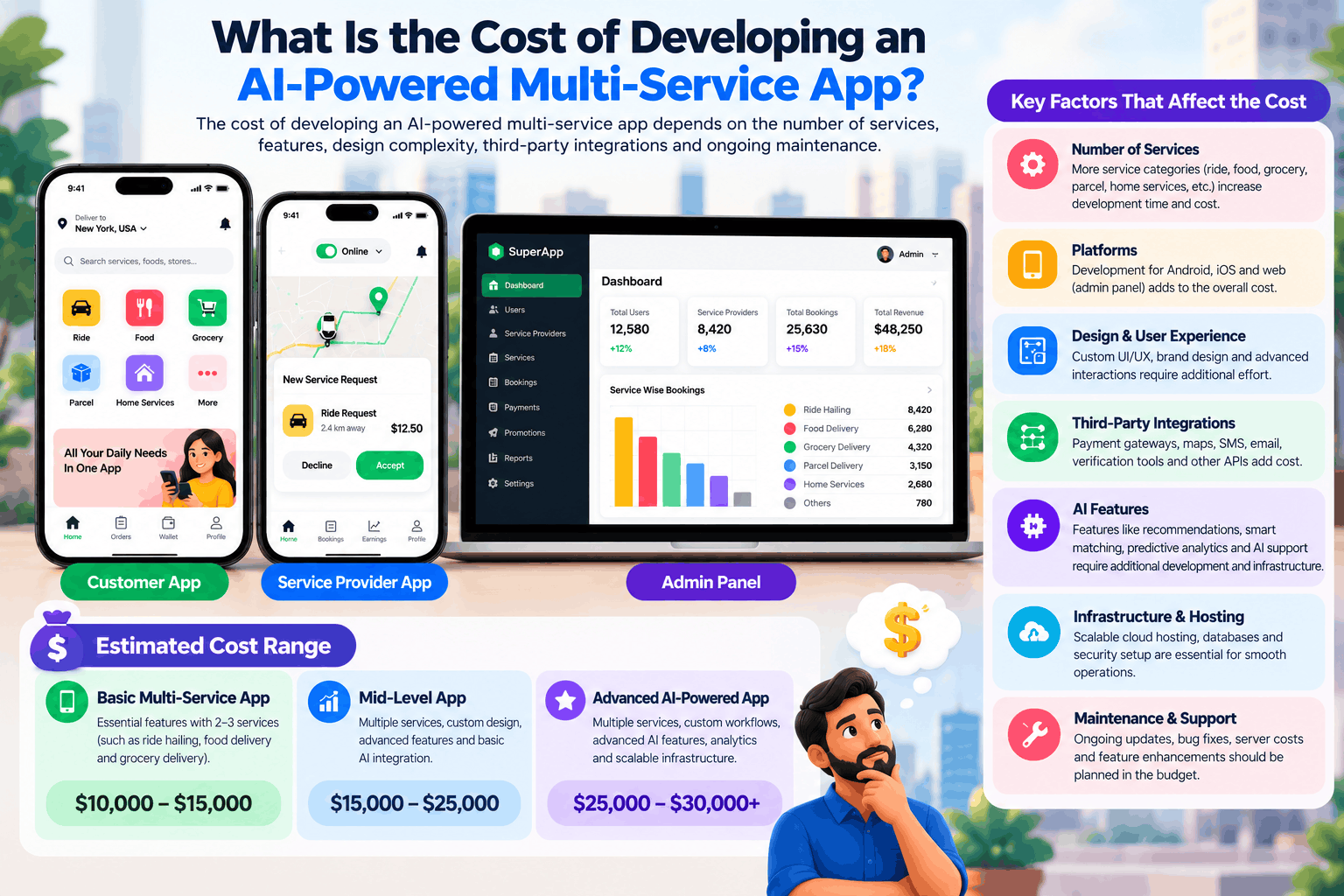
A basic application with essential booking and payment functionality will have different requirements from a mature platform with several service categories, advanced analytics, personalized recommendations, and intelligent automation.
Other cost factors include third-party APIs, cloud hosting, security testing, data preparation, maintenance, and post-launch support.
For most businesses, a phased approach is practical: launch a focused MVP, measure real usage, and invest in additional AI features when there is a clear business case.
Trademark and Branding Considerations
Gojek is a third-party brand. The phrase “Gojek clone app development” is used in this article descriptively to discuss a multi-service application model.
Businesses developing a similar platform should create their own brand identity, original user interface, content, and visual assets. They should not copy Gojek’s logo, protected creative materials, proprietary software, or branding in a way that suggests an official relationship.
Trademark rules vary by jurisdiction, so businesses planning a commercial launch should seek appropriate legal advice where needed.
Frequently Asked Questions
Businesses planning a multi-service platform often have questions about AI integration, development costs, essential features, and choosing the right technology partner. The following FAQs address common considerations around Gojek clone app development, including how AI can improve service delivery, whether existing applications can be upgraded, and what businesses should consider before starting development.
A Gojek clone app is a multi-service application inspired by the super-app model. It can combine services such as transportation, food delivery, grocery shopping, parcel delivery, and home services within a single platform.
AI can support personalized recommendations, intelligent provider matching, demand forecasting, route optimization, customer support automation, and operational analytics.
Yes. AI features can often be integrated into an existing application, depending on its architecture, data quality, available APIs, and security requirements. A technical assessment can identify the most practical starting points.
The timeline depends on the number of services, feature complexity, integrations, design, testing, and team capacity. A focused MVP generally requires less work than a comprehensive platform with advanced AI capabilities.
Review the company’s relevant experience, technical capabilities, security practices, scalability approach, communication process, and post-launch support. Ask for a clear scope of work and an explanation of how proposed AI features will be evaluated.
Final Thoughts
Multi-service platforms offer businesses a way to bring several everyday services into one digital experience. AI adds another layer of opportunity by helping these platforms make more relevant recommendations, anticipate demand, streamline operations, and support customers more effectively.
The strongest approach to Gojek clone app development is not to reproduce another company’s product feature for feature. It is to understand a particular market, identify real customer needs, and build a platform with a clear purpose and room to grow.
An AI-powered Gojek clone app can be a useful starting concept for businesses planning a multi-service platform, provided its features are selected according to actual requirements rather than trends alone. With thoughtful planning, appropriate technology, responsible data practices, and continuous improvement, businesses can develop a distinctive application designed around their own customers and commercial goals.
Disclaimer: Gojek is a third-party brand. PeppyOcean is not affiliated with or endorsed by Gojek. The term “Gojek clone app” is used descriptively to refer to a multi-service application model.

Ankit Patel is the Project Delivery Head at XongoLab Technologies LLP and PeppyOcean, leading mobile app development companies specializing in custom software & mobile app solutions. Passionate about technology and innovation, he enjoys writing about mobile & software development, business, and marketing. His articles have been featured on renowned publications, including YourStory, E27, Datafloq, JaxEnter, TechTarget, Adobe, DesignWebKit, InstantShift, Business Magazine, Simple Programmer, and many others.
You may also like
From On-Demand to AI-Powered: The Next Generation of Apps
-
On-demand apps have changed the way people access transportation, food, healthcare, home services, deliveries, and other everyday services. Customers can request what they need, track progress, make payments, and receive services through a single digital platform. But customer expectations are changing. People increasingly want faster responses, personalized recommendations, accurate updates, and smoother digital experiences. Businesses,… Read More

How to Choose an On Demand App Development Company for Your AI-Powered Business
-
Businesses across industries are moving toward on-demand services as customers increasingly expect convenience, speed, and personalized experiences. From food delivery and transportation to healthcare, home services, logistics, and grocery delivery, on-demand platforms are changing how businesses connect with their customers. The market is also becoming increasingly intelligent. The global AI in transportation market is estimated… Read More
AI in Transportation: How Artificial Intelligence Is Transforming the Way We Move
-
Transportation has always evolved alongside technology. From steam-powered trains to electric vehicles and GPS navigation, every major innovation has changed how people and goods move from one place to another. Today, AI in transportation is becoming another major turning point. Artificial intelligence is helping transportation companies make faster decisions, understand changing travel patterns, improve fleet… Read More
Recent Posts
 Gojek Clone App Development: How AI Is Transforming Multi-Service Apps
 From On-Demand to AI-Powered: The Next Generation of Apps
 How to Choose an On Demand App Development Company for Your AI-Powered Business
 AI in Transportation: How Artificial Intelligence Is Transforming the Way We Move
 How Courier App Development Improves Delivery Operations