
How to Choose an On Demand App Development Company for Your AI-Powered Business

-
Ankit Patel
- September 15, 2026
- 7 min read
Businesses across industries are moving toward on-demand services as customers increasingly expect convenience, speed, and personalized experiences. From food delivery and transportation to healthcare, home services, logistics, and grocery delivery, on-demand platforms are changing how businesses connect with their customers.
The market is also becoming increasingly intelligent. The global AI in transportation market is estimated to reach $5.16 billion in 2026, up from $4.27 billion in 2025, and is projected to reach $10.8 billion by 2030, representing a projected CAGR of 20.3%.
For businesses planning to enter this space, developing an application is only one part of the challenge. They also need scalable technology, intelligent automation, real-time capabilities, and a development partner that understands their long-term goals. This makes choosing the right on demand app development company an important business decision.
Why AI Is Changing On-Demand App Development
Artificial intelligence is becoming an important component of modern on-demand platforms. Instead of simply allowing customers to request a product or service, AI can help applications understand patterns, automate decisions, and create more personalized experiences.
According to the OECD, AI is already being explored and implemented across transportation for applications including route optimization, demand forecasting, predictive maintenance, traffic management, logistics, infrastructure monitoring, safety, and autonomous transportation.
For an on-demand business, these capabilities can improve multiple parts of the customer and operational journey.
For example, an AI-powered application can analyze historical bookings and real-time activity to predict demand. It can recommend suitable service providers, optimize delivery routes, identify unusual activity, and provide personalized recommendations to customers.
This means AI should not simply be treated as an additional feature. Businesses should consider AI integration when planning their application architecture, data strategy, and long-term product roadmap.
The Growing Demand for Faster On-Demand Services
Customer expectations are also pushing businesses to improve the speed and efficiency of their digital services.
A 2026 A&M–CII study of 2,019 Indian consumers across 54 cities found that 77% of respondents expect delivery within two hours. The report also found that India’s quick-commerce market reached ₹65,700 crore in GMV during FY25, nearly 24 times its 2022 level.
These numbers highlight why businesses need technology capable of coordinating customers, service providers, vehicles, inventory, payments, and delivery operations efficiently.
An on-demand platform therefore needs to do more than process orders or bookings. It needs to respond to changing demand, provide accurate information, and help businesses make decisions quickly.
This is where AI-powered on-demand app development can provide an advantage.
What Does an On-Demand App Development Company Do?
An on demand app development company helps businesses design, build, launch, and maintain applications that connect customers with products or services when they need them.
Depending on the business model, an on-demand platform may include:
- Customer mobile application
- Service provider or driver application
- Admin dashboard
- Real-time tracking
- Booking and scheduling
- Digital payments
- Push notifications
- Ratings and reviews
- In-app communication
- Analytics and reporting
- AI-powered recommendations
- Automated customer support
However, development is not simply about implementing a list of features. A capable development partner should understand how the complete business workflow operates.
For example, a taxi platform needs to coordinate passengers, drivers, locations, pricing, payments, and trip status. A home-service platform needs provider availability, scheduling, service areas, customer requests, and reviews.
The development company should therefore be able to translate these business requirements into a reliable digital ecosystem.
7 Things to Consider When Choosing an On-Demand App Development Company
Selecting a development partner can have a long-term impact on your application’s performance, scalability, and ability to evolve. Consider these factors before making a decision.
1. Industry and Business Model Experience
Start by evaluating the company’s experience with on-demand platforms and similar business models.
A food delivery application has different requirements from a ride-hailing, healthcare, logistics, grocery, or home-service platform. Look for an on demand app development company that understands concepts such as real-time requests, provider availability, location-based services, scheduling, cancellations, payments, and service fulfillment.
Ask about previous projects with similar workflows. Relevant experience can help the development team identify potential challenges earlier and recommend practical solutions.
2. AI and Emerging Technology Expertise
If AI is part of your business strategy, assess the development company’s ability to integrate AI into real applications.
A strong on demand app development company should be able to explain how AI can support your specific business instead of simply listing artificial intelligence among its technologies.
Potential applications include:
- Personalized recommendations
- Predictive demand forecasting
- Intelligent provider matching
- Dynamic pricing support
- Route optimization
- AI-powered customer support
- Fraud detection
- Predictive analytics
- Automated workflows
- Customer behavior analysis
The objective should be to use AI where it creates measurable value for customers and operations.
3. Customization and Scalability
Every business has different workflows, customer expectations, and revenue models. Your application should therefore be flexible enough to accommodate those requirements.
Scalability is equally important. An application that performs well with a few thousand users may require significant architectural improvements when the user base and transaction volume increase.
Ask potential development partners how their architecture will handle:
- Increasing users
- Higher transaction volumes
- Multiple locations
- Additional service categories
- New integrations
- Larger databases
- Increased traffic
- AI processing requirements
A scalable architecture reduces the likelihood of expensive redevelopment as the business grows.
4. Full-Stack Development Capabilities
An on-demand platform usually consists of several connected systems rather than a single mobile application.
Your development partner may need to handle mobile applications, backend systems, APIs, databases, cloud infrastructure, payment gateways, GPS services, analytics, and third-party integrations.
Depending on the project, this could include:
- iOS and Android applications
- Web-based administration
- Cloud infrastructure
- API development
- Real-time communication
- GPS and mapping
- Payment integration
- Analytics
- AI and machine learning services
Working with an on demand app development company that can manage these components can simplify communication and reduce integration challenges.
5. Strong UI/UX Design
A technically advanced application can still fail if customers find it difficult to use.
On-demand customers typically want to discover a service, place a request, make a payment, and track progress with minimal friction.
A good UI/UX process should consider every user group. Customers may need simple booking and payment flows, while service providers may require dashboards for requests, earnings, schedules, and navigation.
User testing should be part of the development process to identify unnecessary steps and usability problems before launch.
6. Security and Data Protection
On-demand applications can handle sensitive information such as customer profiles, addresses, location data, payment information, and business records.
Security should therefore be considered from the beginning of development.
Ask the on demand app development company about:
- Secure authentication
- Data encryption
- API security
- Payment protection
- Access controls
- Cloud security
- Security testing
- Data privacy
- Backup and recovery
Strong security practices can protect both the business and its customers as the platform scales.
7. Post-Launch Support
Launching the application is only the beginning.
Once real customers start using the platform, businesses may discover new requirements, performance issues, integration challenges, and opportunities for improvement.
A reliable development partner should provide ongoing maintenance and support, including bug fixes, security updates, performance optimization, operating-system updates, and new feature development.
AI-powered applications may require additional monitoring because models and data-driven features can change in effectiveness as user behavior evolves.
Essential Features of an AI-Powered On-Demand App
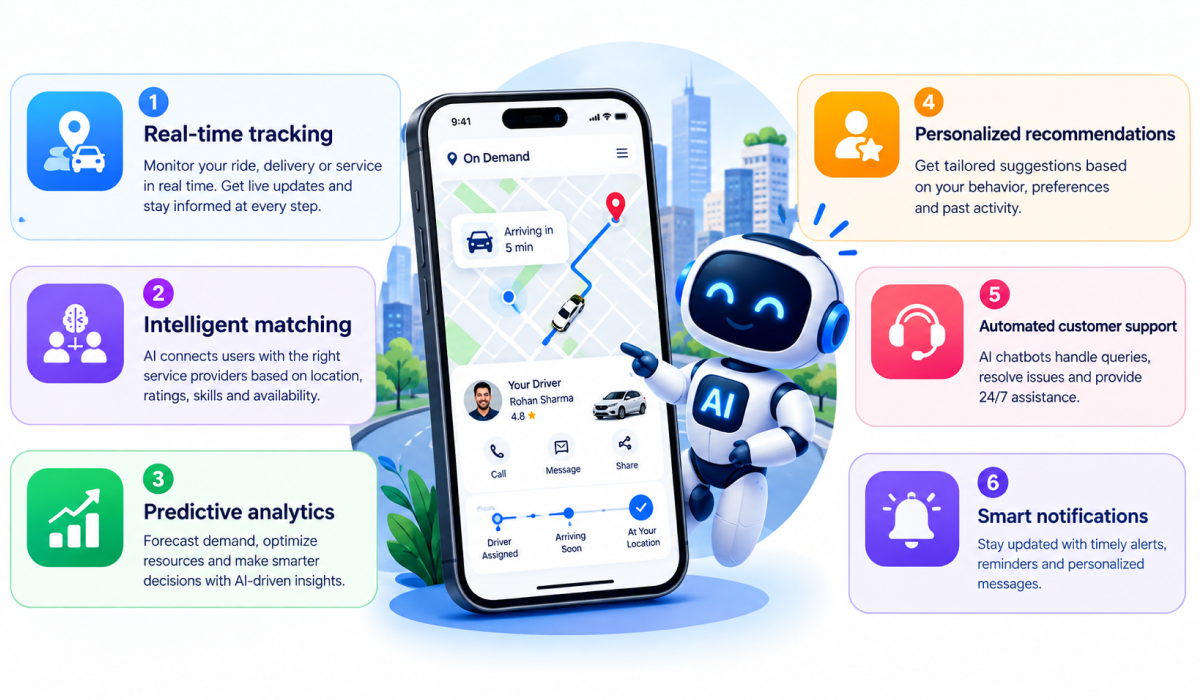
The exact feature set depends on the business model, but several capabilities can provide strong value.
Real-time tracking allows customers and administrators to monitor orders, vehicles, or service providers.
Intelligent matching can connect customers with suitable providers based on location, availability, preferences, and service requirements.
Predictive analytics can help businesses understand demand patterns and allocate resources more efficiently.
Personalized recommendations can use customer behavior and service history to suggest relevant products or services.
Automated customer support can handle common questions and assist customers without requiring human intervention for every request.
Smart notifications can keep customers and providers informed about bookings, status updates, payments, and other important events.
Together, these capabilities can turn a conventional on-demand application into a more intelligent service platform.
AI Can Deliver Measurable Operational Value
Predictive maintenance is one example of how AI can move beyond convenience and create measurable operational value.
Traditional maintenance often depends on fixed schedules or reactive repairs. AI-powered predictive maintenance can analyze sensor information, vehicle performance, telematics, and historical maintenance records to identify potential issues earlier.
An OECD review cites a Maersk example where predictive capabilities helped reduce maintenance costs by up to 20% while improving fleet reliability and maintenance planning.
For an on-demand business, avoiding unexpected vehicle or equipment downtime can have a direct impact on service availability and customer satisfaction.
Custom or Ready-Made On-Demand App?
Businesses often need to decide between a ready-made platform and custom on-demand app development.
A ready-made solution can provide a faster starting point and may suit businesses with straightforward requirements. However, customization, integrations, branding, and scalability can become limitations as the business grows.
Custom development offers greater control over functionality, user experience, integrations, data, and future expansion. It can be particularly useful when AI, automation, or complex workflows are central to the business model.
The right choice ultimately depends on your budget, timeline, business complexity, and long-term growth strategy.
Why the Right Development Partner Matters
The intelligent transportation systems market alone is projected to grow from $42.55 billion in 2025 to $55.36 billion by 2030, demonstrating continued investment in connected and intelligent transportation technologies.
For businesses entering the on-demand economy, this makes technology strategy increasingly important.
The right on demand app development company should be able to combine product strategy, UI/UX design, software engineering, AI integration, security, scalability, and post-launch support.
Rather than choosing a provider solely because it offers the lowest development quote, evaluate its technical capabilities, relevant experience, development process, portfolio, communication, and long-term support model.
Frequently Asked Questions
Choosing the right development partner involves more than comparing features, pricing, or technical skills. These frequently asked questions cover the key considerations businesses should understand when exploring on-demand app development, AI integration, development costs, and the process of selecting the right technology partner.
An on-demand app development company specializes in building digital platforms that connect customers with products or services whenever they need them. These platforms can include mobile apps, provider applications, admin dashboards, payments, tracking, and AI-powered features.
AI can support personalized recommendations, demand forecasting, intelligent provider matching, route optimization, predictive analytics, automated customer support, and other business workflows.
The cost depends on factors such as the number of platforms, features, UI/UX requirements, backend complexity, integrations, AI capabilities, security requirements, and development location. A basic MVP will generally require less investment than a large multi-service platform.
A ready-made solution may be suitable for businesses that need a faster launch with standard functionality. Custom development is generally more appropriate when a business requires unique workflows, advanced integrations, AI features, or long-term scalability.
Look for relevant industry experience, technical expertise, AI integration capabilities, scalable architecture, strong security practices, UI/UX expertise, transparent communication, and reliable post-launch maintenance and support.
Final Thoughts
The on-demand economy is evolving from simple booking and delivery applications toward intelligent platforms that can predict demand, personalize experiences, automate workflows, and improve operational efficiency.
At the same time, customer expectations continue to rise. With 77% of surveyed Indian consumers expecting delivery within two hours, businesses need technology that can coordinate complex operations while maintaining speed and reliability.
Choosing the right on demand app development company can help turn these requirements into a scalable digital product. Look for a partner with strong industry knowledge, AI capabilities, scalable architecture, security expertise, thoughtful UI/UX, and dependable post-launch support.
The best development partner is not simply the one that can build an application. It is the one that can help you create an intelligent, scalable, and customer-focused on-demand business ready for the next stage of digital growth.

Ankit Patel is the Project Delivery Head at XongoLab Technologies LLP and PeppyOcean, leading mobile app development companies specializing in custom software & mobile app solutions. Passionate about technology and innovation, he enjoys writing about mobile & software development, business, and marketing. His articles have been featured on renowned publications, including YourStory, E27, Datafloq, JaxEnter, TechTarget, Adobe, DesignWebKit, InstantShift, Business Magazine, Simple Programmer, and many others.
You may also like
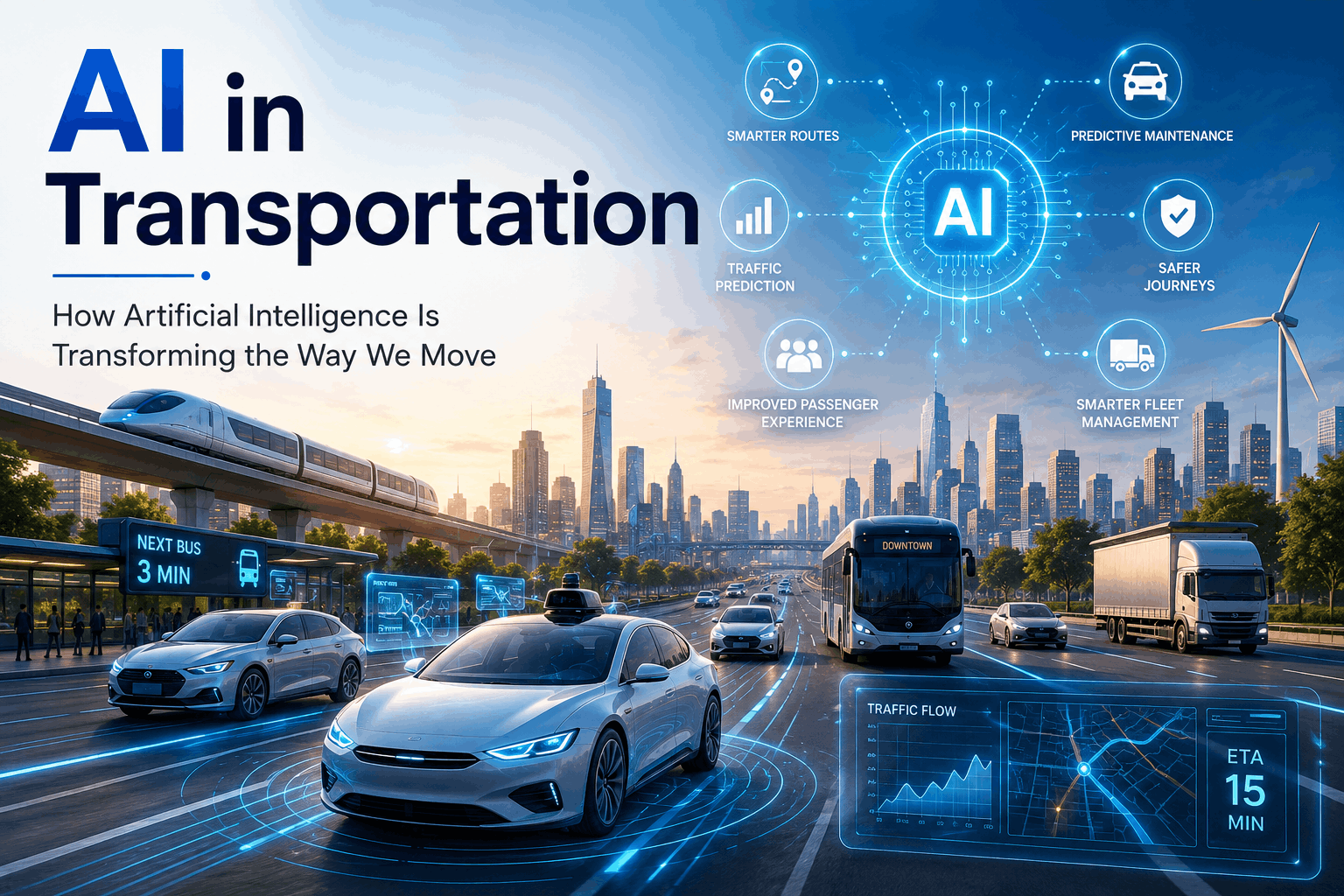
AI in Transportation: How Artificial Intelligence Is Transforming the Way We Move
-
Transportation has always evolved alongside technology. From steam-powered trains to electric vehicles and GPS navigation, every major innovation has changed how people and goods move from one place to another. Today, AI in transportation is becoming another major turning point. Artificial intelligence is helping transportation companies make faster decisions, understand changing travel patterns, improve fleet… Read More

How Courier App Development Improves Delivery Operations
-
A customer places an order and expects one thing: the package should arrive when promised. Behind that simple expectation, courier businesses have to coordinate orders, drivers, routes, payments, tracking, customer updates, and delivery schedules every day. As delivery volumes grow, managing these activities through spreadsheets, phone calls, or disconnected systems becomes difficult. A small delay… Read More
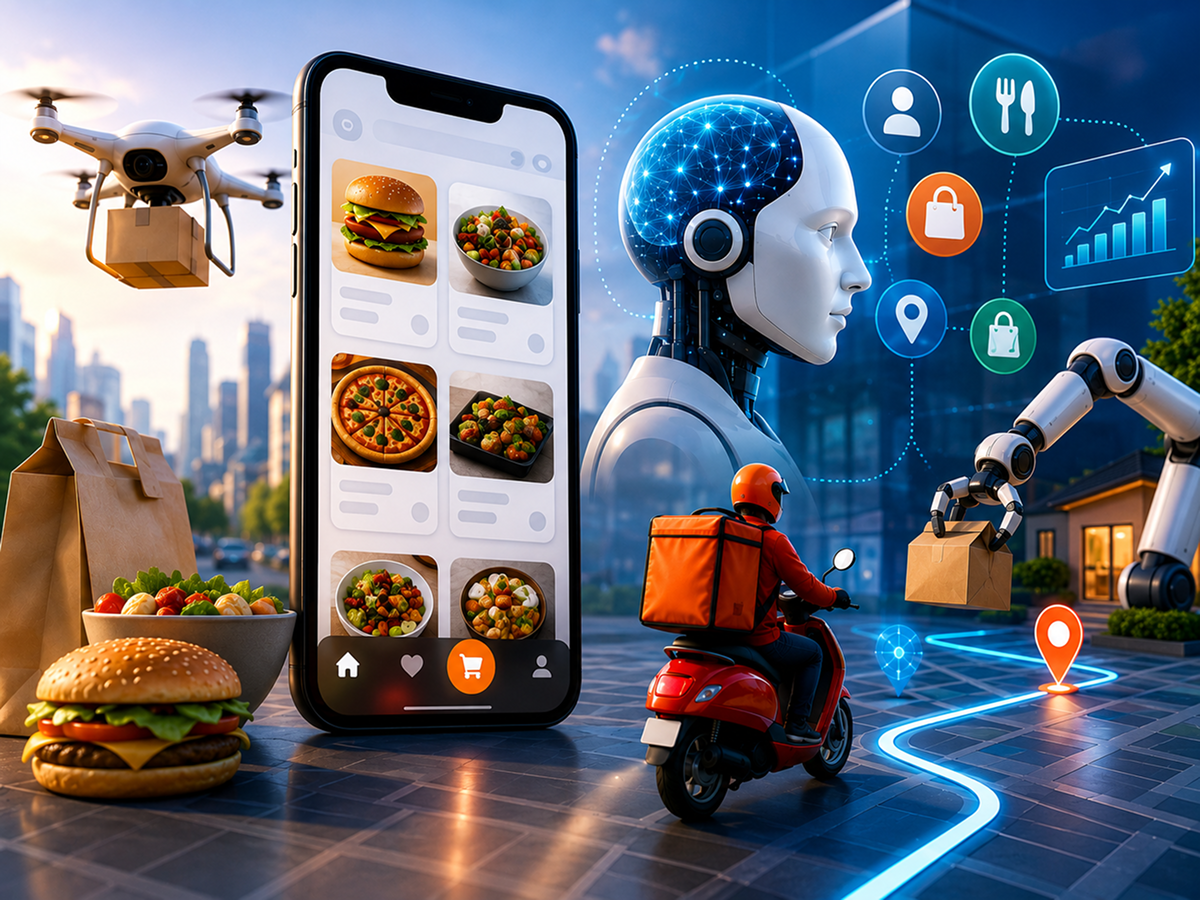
How AI Can Improve Your Food Delivery App with Intelligent Automation
-
The online food delivery industry has experienced tremendous growth over the past decade. Customers now expect more than just a platform to place food orders—they demand personalized recommendations, lightning-fast deliveries, real-time tracking, accurate ETAs, seamless customer support, and an overall hassle-free experience. As competition continues to grow, simply having a Food Delivery App is no… Read More
Recent Posts
 How to Choose an On Demand App Development Company for Your AI-Powered Business
 AI in Transportation: How Artificial Intelligence Is Transforming the Way We Move
 How Courier App Development Improves Delivery Operations
 How AI Can Improve Your Food Delivery App with Intelligent Automation
 How AI Can Upgrade Your Existing Taxi App to Increase Bookings and Revenue