
Inside the Super App: How a Gojek Clone Actually Works — and How AI Is Rewriting the Blueprint
-
Ankit Patel
- June 29, 2026
- 7 min read
Open Gojek in Jakarta and you can hail a motorbike, pay your electricity bill, order nasi goreng, send a parcel across town, and book a massage — without ever leaving the app or typing a card number. To a Western user raised on single-purpose apps, it looks like chaos. To 190 million people in Southeast Asia, it’s just Tuesday.
That difference is the whole story. A super app isn’t a bigger app — it’s a different idea about what an app is for. And a Gojek clone isn’t a copy of Gojek’s screens; it’s a way to inherit a business model that took a decade and billions of dollars to prove. If you’re an entrepreneur or enterprise weighing super app development, the worst thing you can do is treat it as a feature checklist. So let’s do the opposite. Let’s take the thing apart and see what actually makes it run.
What a super app really is (the part most guides skip)
Here’s the mental model worth carrying around: a super app is a marketplace of marketplaces held together by a wallet.
Each individual service — rides, food, groceries — is its own two-sided marketplace, matching people who want something with people who can provide it. On their own, those are ordinary on-demand apps. What turns a pile of services into a super app is the connective tissue: one login, one profile, one payment method, and one stream of behavioural data flowing between them all.
The payoff isn’t convenience for its own sake. It’s economics. Acquiring a customer is expensive; the genius of the multi-service app model is that you pay to acquire someone once, then earn from them across five, ten, twenty services. The food customer becomes the ride customer becomes the bill-payment customer. Your cost to acquire stays flat while your revenue per user climbs. That’s the engine. Everything else is plumbing.
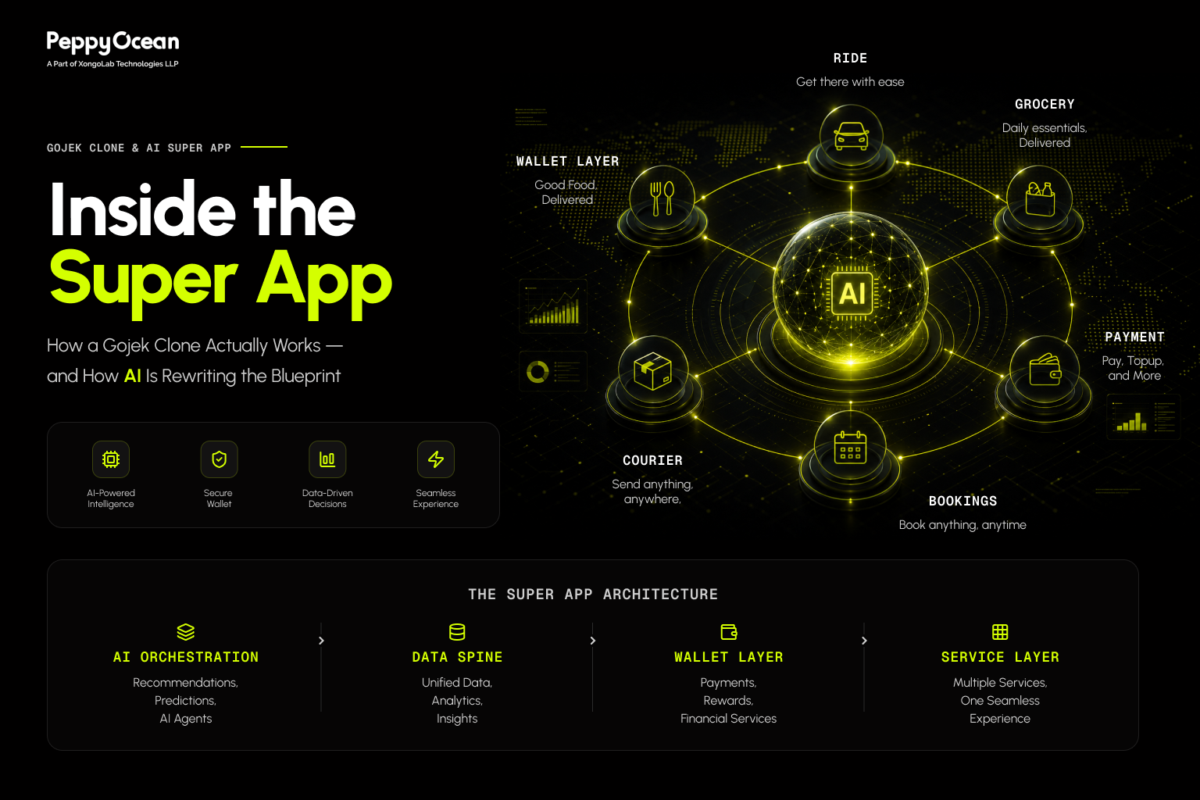
The anatomy: four layers that make it work
If you sketched a super app on a napkin, you’d draw four stacked layers. Understanding them is what separates a founder who briefs a developer well from one who gets surprised six months in.
Layer 1 — The services
These are the verticals users actually touch: ride-hailing, food delivery, grocery, courier and parcel, bill payments, bookings. Each needs its own logic — a ride needs live GPS matching, a grocery order needs inventory and substitutions. In a well-built Gojek clone, these are modules, not a monolith. You can switch one on, tune it, or turn it off without breaking the others.
Layer 2 — The wallet (this is the gravity)
The in-app wallet is the single most underrated piece of the whole machine. It does three quiet but enormous jobs. It removes friction at checkout, because returning users never re-enter payment details. It creates lock-in, because money sitting in your wallet is a reason to come back. And it generates a closed loop of transaction data you own outright. When people ask why Grab and Gojek fought so hard to become payment companies, this is the answer: the wallet is the gravity that holds the services in orbit.
Layer 3 — The data spine
Every tap, search, route, and reorder is a signal. The data spine is the shared layer that collects those signals across services and makes them available to the whole platform. A user who orders dinner at 9pm every Friday and books a ride home from the same bar district is telling you something. Without a unified data spine, that insight is trapped inside one service. With it, the whole app gets smarter.
Layer 4 — The orchestration layer (where AI now lives)
This is the brain that decides what to show, when, and to whom — which service to surface on the home screen, which promo to send, which driver to assign. For most of the super app era this layer ran on hand-tuned rules. In 2026, it increasingly runs on AI. This is the layer that has changed the most, and it’s where the rest of this guide is headed.
Why the “clone” route works — and where founders get it wrong
“Clone” is an unfortunate word. It makes people picture a cheap knock-off. What a Gojek clone app really offers is a proven architecture — those four layers, already designed, wired, and tested — so you skip the most expensive years of trial and error and start from a working foundation.
That’s the upside. Here’s the trap, and almost everyone falls into it: launching all twenty services at once.
Gojek didn’t start as a super app. It started as a call centre for motorbike taxis. Grab started with rides. Careem started with rides. WeChat started as a messaging app and bolted on payments later. Every super app you admire began as one service done well, then expanded once it had a loyal base and a working wallet. The clone gives you the full blueprint, but the blueprint is not the build order. The smart move is to pick a wedge — the one service your market is starving for — win it, then layer the others on top using the audience and wallet you’ve already built.
If you remember one thing from this section: buy the architecture, but earn the expansion.
The AI layer that changes everything in 2026
For most of its history, the super app was a logistics achievement. The new chapter is an intelligence one. An AI super app doesn’t just connect services — it anticipates them. Here’s what that looks like in practice, layer by layer.
Recommendation and cross-sell. The old home screen showed everyone the same grid of icons. An AI-driven one reorders itself per person and per moment — groceries on Sunday morning, rides on Friday night, pharmacy when someone’s order history hints at a sick kid. Done well, this lifts the revenue-per-user that makes the whole model work, without a single new customer.
Demand prediction. AI forecasts where rides will be needed before riders open the app, and how much stock a dark store should hold before orders come in. That means shorter waits, fewer stockouts, and drivers positioned where the money is. Predictive analytics turns a reactive platform into a proactive one.
Conversational ordering. Increasingly, the interface is a sentence. “Get me a cab to the airport and order my usual coffee for pickup on the way” is now a single instruction an AI agent can execute across two services. Conversational AI collapses the twenty-tap journey into one. For older users, non-native speakers, and anyone in a hurry, that’s not a gimmick — it’s access.
AI agents that act, not just answer. This is the genuinely new frontier. An AI agent can be handed a goal — “plan my Saturday errands within a two-hour window and a 500-rupee budget” — and it will sequence the grocery run, the pharmacy pickup, and the courier drop, then book them. The app stops being a menu you navigate and becomes an assistant you delegate to. Super apps, with all their services already under one roof, are the most natural home for this kind of agentic commerce that exists.
Fraud and trust. The same data spine that powers recommendations powers safety. AI flags a stolen card, a fake driver account, or an abnormal refund pattern in real time, protecting both the float in your wallet and the trust users place in the platform.
Notice that none of these are bolt-ons. They all draw from Layer 3 and live in Layer 4. AI isn’t a feature you sprinkle on a super app — it’s the orchestration layer finally growing up.
A build blueprint you can actually follow
Here’s a phased path that respects both the architecture and the build order.
Phase 1 — The wedge. Launch one service (usually rides or food, because demand is dense and habits are daily). Build it on a modular foundation so the other layers can slot in later. Get the wallet live from day one, even if it only powers one service — you want the gravity working early.
Phase 2 — The second service and the data spine. Add a complementary vertical (food after rides, or grocery after food) and stand up the shared data layer so the two services start informing each other. This is where cross-sell first earns its keep.
Phase 3 — The intelligence layer. Now that you have real behavioural data, introduce AI: personalised home screens, demand prediction, smarter dispatch. You couldn’t have done this in Phase 1 — AI needs data to learn from, and in Phase 1 you had none.
Phase 4 — The platform. Open up to more services, third-party merchants, and AI agents. This is the true super app: a marketplace of marketplaces, orchestrated by intelligence, glued together by a wallet.
The mistake is trying to do Phase 4 on day one. The discipline is doing Phase 1 so well that Phase 4 becomes inevitable.
What the giants actually teach
Each major player teaches a different lesson worth stealing. Gojek proved that hyper-local service density (it started with motorbikes because that’s how Jakarta moves) beats a generic global template. Grab showed that the wallet, not the ride, is the real moat. WeChat demonstrated that a super app can grow out of an unrelated core — messaging — if the wallet and mini-programs are strong enough. Careem proved the model travels: a region-specific super app can win against global incumbents by understanding local payment habits and languages. The pattern underneath all of them is the same four layers — and increasingly, the same AI orchestration on top.
A few myths worth retiring
“A super app needs millions of users to make sense.” No — it needs depth in one market before breadth in services. A focused regional multi-service app with three tightly integrated services can be far healthier than a sprawling one with twelve nobody uses.
“AI is a phase-four luxury.” Increasingly false. Conversational ordering and AI dispatch are becoming table stakes, and starting your data spine early is what makes them possible later. You don’t have to ship AI on day one, but you should architect for it from day one.
“Clone means generic.” Only if you treat it that way. The architecture is shared; the wedge, the local insight, the AI experience, and the brand are entirely yours.
CTA
You don’t need to copy Gojek. You need to understand it — and then build the version your market is actually waiting for. If you’re mapping out super app development and want a partner who treats AI as the architecture rather than a buzzword, PeppyOcean builds modular, AI-ready Gojek clone platforms designed to start with a wedge and scale into a full super app. Book a free strategy call and we’ll help you choose the right first service and sketch the path to the rest.

Ankit Patel is the Project Delivery Head at XongoLab Technologies LLP and PeppyOcean, leading mobile app development companies specializing in custom software & mobile app solutions. Passionate about technology and innovation, he enjoys writing about mobile & software development, business, and marketing. His articles have been featured on renowned publications, including YourStory, E27, Datafloq, JaxEnter, TechTarget, Adobe, DesignWebKit, InstantShift, Business Magazine, Simple Programmer, and many others.
You may also like
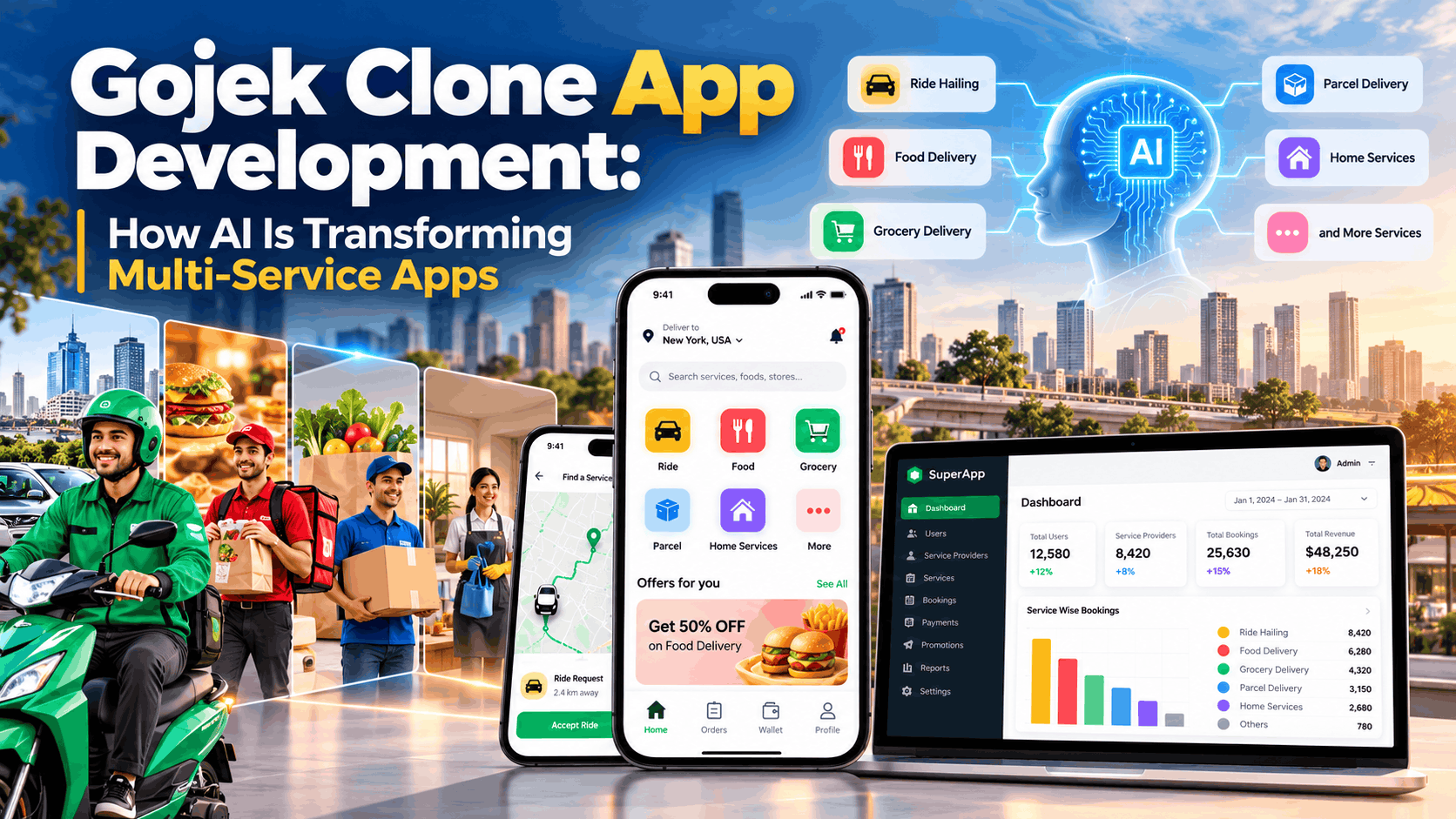
Gojek Clone App Development: How AI Is Transforming Multi-Service Apps
-
Customers increasingly expect digital platforms to handle multiple everyday needs through a single application. From booking rides and ordering food to purchasing groceries, sending parcels, and hiring professionals, convenience has become a major part of the digital service experience. This shift has created opportunities for entrepreneurs looking to build multi-service platforms inspired by successful super-app… Read More
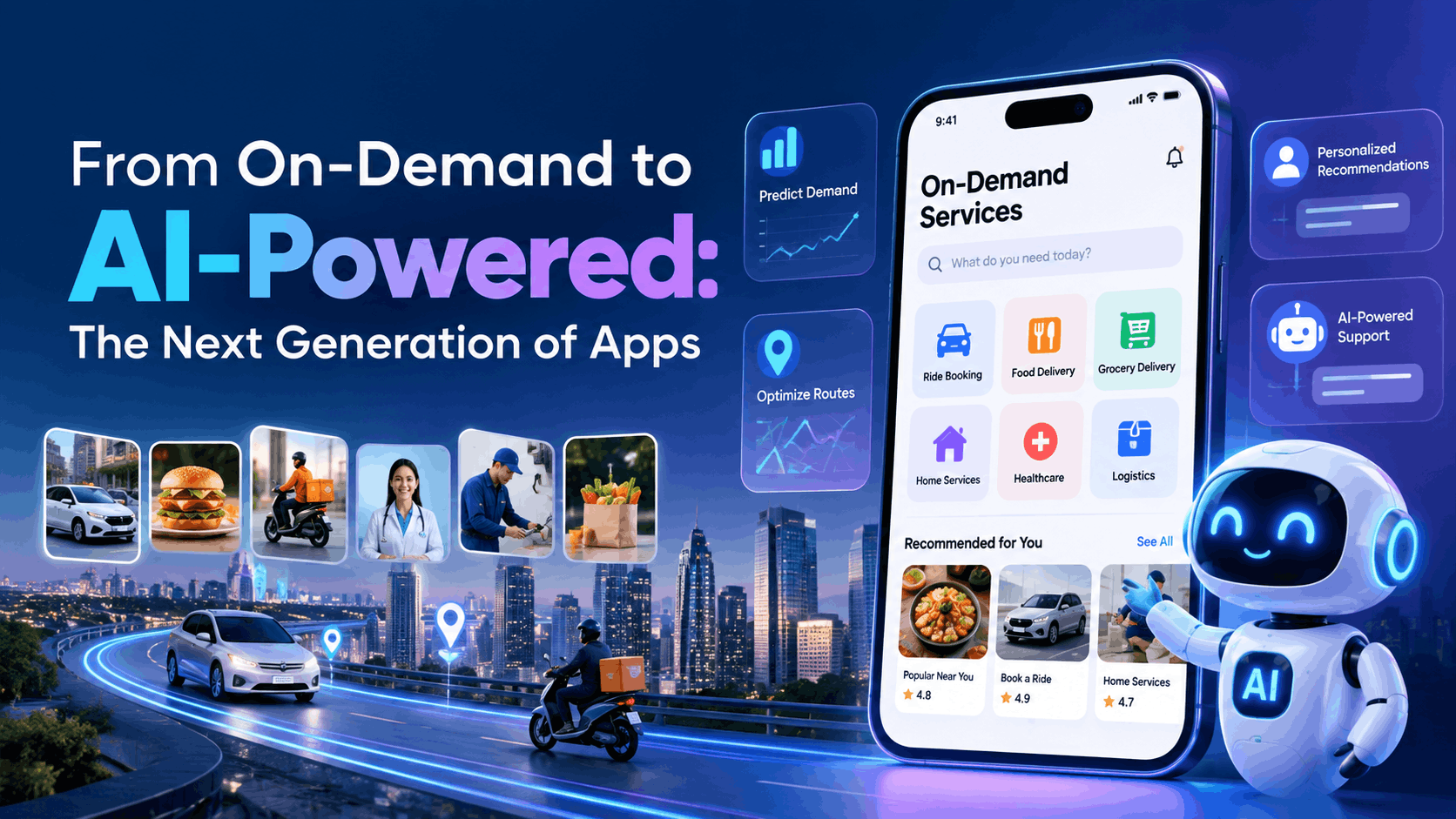
From On-Demand to AI-Powered: The Next Generation of Apps
-
On-demand apps have changed the way people access transportation, food, healthcare, home services, deliveries, and other everyday services. Customers can request what they need, track progress, make payments, and receive services through a single digital platform. But customer expectations are changing. People increasingly want faster responses, personalized recommendations, accurate updates, and smoother digital experiences. Businesses,… Read More

How to Choose an On Demand App Development Company for Your AI-Powered Business
-
Businesses across industries are moving toward on-demand services as customers increasingly expect convenience, speed, and personalized experiences. From food delivery and transportation to healthcare, home services, logistics, and grocery delivery, on-demand platforms are changing how businesses connect with their customers. The market is also becoming increasingly intelligent. The global AI in transportation market is estimated… Read More
Recent Posts
 Gojek Clone App Development: How AI Is Transforming Multi-Service Apps
 From On-Demand to AI-Powered: The Next Generation of Apps
 How to Choose an On Demand App Development Company for Your AI-Powered Business
 AI in Transportation: How Artificial Intelligence Is Transforming the Way We Move
 How Courier App Development Improves Delivery Operations