
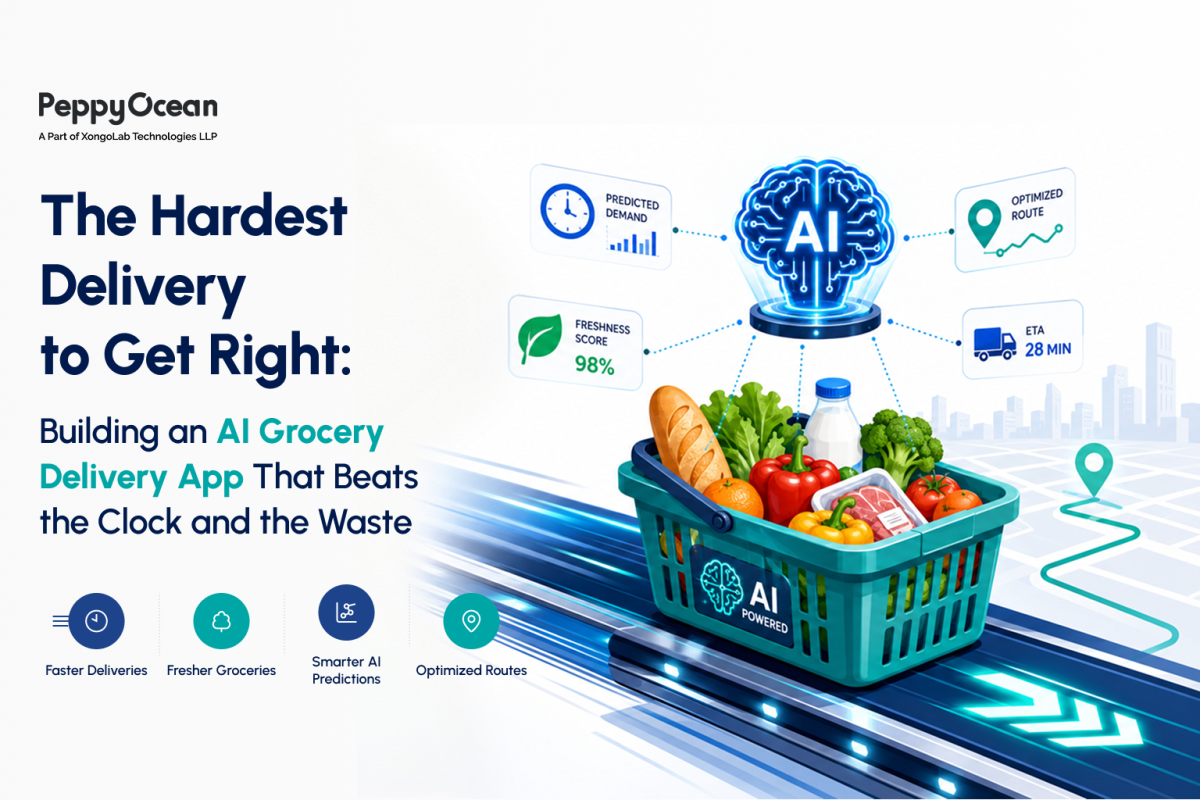
The Hardest Delivery to Get Right: Building an AI Grocery Delivery App That Beats the Clock and the Waste
-
Ankit Patel
- July 06, 2026
- 5 min read
Order a phone case online and the warehouse has months to ship it. Order a punnet of strawberries and you have, generously, two days before they turn to jam — and about thirty minutes before an impatient customer cancels. That single contrast explains why grocery delivery app development is the most unforgiving corner of the on-demand world, and why so many well-funded grocery startups have quietly folded.
Groceries combine everything that’s hard about logistics. Thousands of items instead of a handful. Perishability. Wild demand swings between a sleepy Tuesday and a pre-holiday Saturday. Razor-thin margins where a single wrong substitution can cost you the customer forever. If ride-hailing is a matching problem and parcels are a routing problem, groceries are all of that plus a race against time and rot. The good news: this is exactly the kind of problem artificial intelligence was made for. Let’s walk through why groceries are so brutal — and how an AI grocery delivery platform turns each weakness into an edge.
The mental model: you’re not delivering products, you’re managing decay
Here’s the frame worth keeping. In most delivery businesses, the product sits patiently until someone wants it. In groceries, the product is actively losing value from the moment it arrives. Every hour a crate of spinach sits unsold is money evaporating. Every item you over-order spoils; every item you under-order is a sale you lost and a customer you disappointed.
So the real job of a grocery platform isn’t moving boxes. It’s making thousands of tiny predictions — how much, of what, where, by when — accurately enough to keep shelves full without filling the bin. Get those predictions right and you’re profitable. Get them wrong and no amount of slick app design will save you. That prediction problem is where AI earns its keep, and it’s the thread running through everything below.
Where AI actually changes the economics
It’s easy to slap “AI-powered” on a landing page. It’s more useful to know exactly where intelligence moves the numbers. There are four places it matters most.
Demand forecasting that respects perishables
A generic sales forecast says “you’ll sell roughly 200 units of milk this week.” A grocery-grade forecast says “you’ll sell 38 units of milk on Thursday in this specific dark store, rising to 61 on Saturday, with a spike if it rains.” That granularity is the difference between fresh shelves and a skip full of expired stock. Demand forecasting powered by AI reads seasonality, weather, local events, paydays, and a store’s own history to order the right quantity of the right items for the right day. For a perishable business, this isn’t a nice-to-have — it’s the whole margin.
The substitution problem nobody talks about
Out-of-stocks are inevitable in groceries; the question is what happens next. Substitute a customer’s organic almond milk with regular dairy and you haven’t solved a problem, you’ve created a complaint. AI substitution looks at what the shopper actually values — brand loyalty, dietary flags, price sensitivity, past acceptances — and proposes a swap they’ll genuinely accept, or asks in real time. Handled well, smart-basket intelligence turns a moment of friction into a moment of trust.
Personalised baskets and reorder nudges
Most grocery shopping is repetitive — the same staples, week after week. AI quietly learns each household’s rhythm and rebuilds the basket before the customer does, surfacing “you usually reorder coffee around now” without being creepy about it. A strong recommendation engine doesn’t just lift basket size; it removes the chore from a chore-driven category, which is the single biggest reason people stay.
Dynamic slot and route optimisation
Every delivery slot you promise is a promise you have to keep, profitably. AI balances how many orders to accept per slot against the staff and riders available, then sequences drops so a single trip serves several nearby homes while the cold items are still cold. This is where the quick commerce promise — ten minutes, thirty minutes — either holds up or collapses.
The build: more than a pretty storefront
Founders often picture a grocery app as a catalogue with a checkout button. The screens are the easy 20%. The hard 80% lives behind them, and a serious grocery marketplace app is really four connected systems.
There’s the customer app — browsing, search, basket, payments, live tracking. There’s the inventory and catalogue engine — thousands of SKUs, real-time stock, pricing, and the substitution logic above. There’s the operations layer — picker apps inside the store or dark store, batching, and quality checks. And there’s the rider and dispatch layer — assignment, routing, and proof of delivery. The AI orchestration sits across all four, because a forecast is only useful if it reaches the buyer who places the order and the picker who fills it.
A clone-based foundation — think Instacart clone architecture — gives you these four systems pre-wired, so you spend your energy on the AI tuning and local market fit rather than rebuilding plumbing that thousands of grocery apps already share.
A phased path that won’t bankrupt you
Grocery is capital-hungry, so sequencing matters even more than usual.
Phase 1 — One catchment, one model. Launch in a single dense area with one fulfilment model (a partner supermarket or one dark store). Keep the SKU range tight. Your goal here is clean data, not coverage.
Phase 2 — Teach the model. With real orders flowing, switch on demand forecasting and substitution AI. A few weeks of genuine local data beats any off-the-shelf assumption. This is the phase where margins start to turn.
Phase 3 — Densify, then expand. Add slots, riders, and SKUs within your proven area before adding new areas. Density is what makes routing efficient; a thin spread across a whole city is how grocery apps bleed cash.
Phase 4 — Platform and personalisation. Layer in personalised baskets, reorder automation, and eventually multiple stores or a marketplace of vendors. Now the AI grocery delivery platform is a habit, not an experiment.
The recurring mistake is launching city-wide with 15,000 SKUs to look impressive. Impressive doesn’t pay rent. Density and accuracy do.
What the leaders quietly figured out
Instacart’s real asset was never the app — it was years of substitution and shopper-behaviour data that made its recommendations hard to beat. The ten-minute players in India and the Gulf proved that dark stores plus tight forecasting can make absurd speed profitable in dense cities — and ruinous in sparse ones. The lesson underneath both: in groceries, the company with the best predictions wins, not the company with the most features. That’s a strategy you can copy deliberately, rather than stumbling into it.
Myths worth dropping
“Faster is always better.” Only where density supports it. A reliable 30-minute slot in a spread-out suburb beats a broken 10-minute promise every time. Speed is a feature of geography as much as technology.
“AI is for later, once we scale.” Backwards. The forecasting and substitution models that protect your margin are most valuable early, when every spoiled crate hurts. Architect for data from day one even if you switch the models on in Phase 2.
“A grocery app is just an e-commerce app with food.” No. E-commerce tolerates a two-day wait and a stable product. Groceries tolerate neither. The whole engineering and AI emphasis is different.

Ankit Patel is the Project Delivery Head at XongoLab Technologies LLP and PeppyOcean, leading mobile app development companies specializing in custom software & mobile app solutions. Passionate about technology and innovation, he enjoys writing about mobile & software development, business, and marketing. His articles have been featured on renowned publications, including YourStory, E27, Datafloq, JaxEnter, TechTarget, Adobe, DesignWebKit, InstantShift, Business Magazine, Simple Programmer, and many others.
You may also like
Gojek Clone App Development: How AI Is Transforming Multi-Service Apps
-
Customers increasingly expect digital platforms to handle multiple everyday needs through a single application. From booking rides and ordering food to purchasing groceries, sending parcels, and hiring professionals, convenience has become a major part of the digital service experience. This shift has created opportunities for entrepreneurs looking to build multi-service platforms inspired by successful super-app… Read More
From On-Demand to AI-Powered: The Next Generation of Apps
-
On-demand apps have changed the way people access transportation, food, healthcare, home services, deliveries, and other everyday services. Customers can request what they need, track progress, make payments, and receive services through a single digital platform. But customer expectations are changing. People increasingly want faster responses, personalized recommendations, accurate updates, and smoother digital experiences. Businesses,… Read More

How to Choose an On Demand App Development Company for Your AI-Powered Business
-
Businesses across industries are moving toward on-demand services as customers increasingly expect convenience, speed, and personalized experiences. From food delivery and transportation to healthcare, home services, logistics, and grocery delivery, on-demand platforms are changing how businesses connect with their customers. The market is also becoming increasingly intelligent. The global AI in transportation market is estimated… Read More
Recent Posts
 Gojek Clone App Development: How AI Is Transforming Multi-Service Apps
 From On-Demand to AI-Powered: The Next Generation of Apps
 How to Choose an On Demand App Development Company for Your AI-Powered Business
 AI in Transportation: How Artificial Intelligence Is Transforming the Way We Move
 How Courier App Development Improves Delivery Operations