
The 30-Minute Promise: How AI Food Delivery Apps Actually Make the Math Work
-
Ankit Patel
- July 09, 2026
- 5 min read
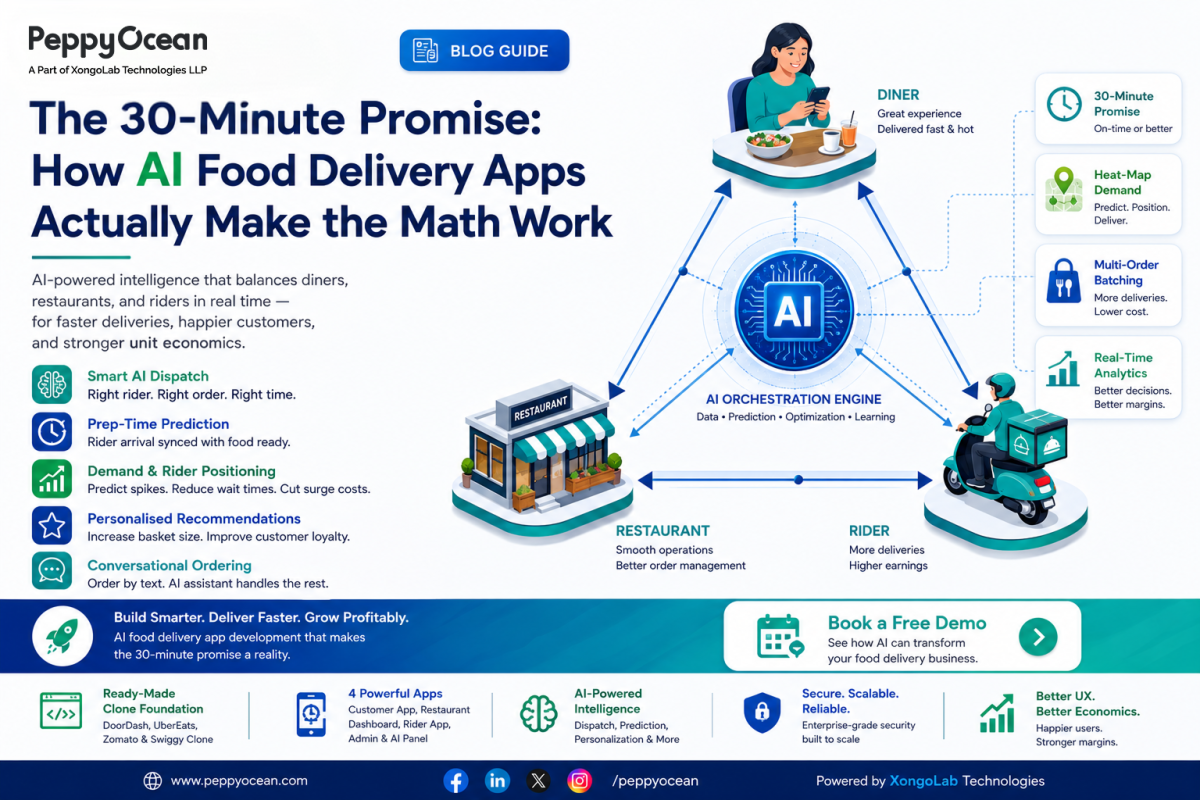
A food delivery order looks simple from the couch. Tap, wait, eat. Behind that tap is one of the most fragile real-time balancing acts in commerce: a hungry person who wants their food hot and now, a restaurant juggling a dozen tickets at once, and a rider who could be anywhere in a five-mile radius. Get the timing wrong by eight minutes and the fries are cold, the rating drops, and a customer you paid good money to win never comes back.
That fragility is why food delivery app development is less about screens and more about choreography. The famous brands didn’t win because their apps were prettier. They won because they got better at orchestrating three impatient parties in real time — and, increasingly, because they handed that orchestration to AI. If you’re building in this space, the useful question isn’t “what features do I need?” It’s “how does the math actually work, and where does intelligence tip it in my favour?” Let’s get into it.
The mental model: a three-sided marketplace racing a clock
Most guides describe food delivery as a two-sided marketplace — diners and restaurants. That misses the hardest party: the rider. A food platform is a three-sided marketplace, and all three sides have to be balanced simultaneously and continuously, not once at checkout.
Too few riders and food sits congealing on a counter. Too many and they idle unpaid, and your costs balloon. A restaurant that under-times its cooking leaves a rider waiting; one that over-promises leaves a diner fuming. Demand also moves in vicious spikes — a rainy Friday at 8pm can be ten times a wet Tuesday at 3pm. Balancing three sides against a clock that’s always ticking is the real product. Everything else is interface.
Where the money leaks — and where AI plugs it
Food delivery is notorious for thin or negative margins. That’s not destiny; it’s the sum of small inefficiencies, each of which AI can attack.
Smart dispatch is the whole game
The single highest-leverage decision a food platform makes, thousands of times an hour, is which rider gets which order. Assign by simple distance and you’ll send a rider to a kitchen whose food isn’t ready, or split two orders that could have ridden together. AI dispatch weighs live traffic, how busy the kitchen is, where the rider is heading next, and whether nearby orders can be batched — then makes the assignment that keeps food hot and rider time productive. Route optimization at the dispatch layer is where a money-losing delivery becomes a profitable one.
Prep-time prediction
The quiet killer of food delivery is the gap between “rider arrives” and “food is ready.” AI learns each restaurant’s real rhythm — this kitchen runs eleven minutes slow on Friday nights — and times the rider’s arrival to the food, not to a naive guess. Less waiting means happier riders, fresher food, and more deliveries per hour from the same fleet.
Demand prediction and rider positioning
If you know the 8pm rain spike is coming, you can nudge riders toward the busy districts before orders land, instead of scrambling after. Predictive analytics smooths the spikes that otherwise force you into expensive surge incentives, and shaves the wait times that lose customers.
Personalisation that lifts the basket
The home screen is prime real estate. An AI recommendation engine that surfaces the dish someone actually wants — and the dessert they tend to add on a Friday — lifts average order value without a single extra marketing dollar. In a thin-margin business, a few percentage points on basket size is the difference between red and black.
Conversational and agentic ordering
The newest shift: ordering by sentence. “Order my usual from the Thai place and add spring rolls” is now a single instruction an conversational AI assistant can fulfil. Push it further and an AI agent can plan a group dinner across dietary needs and budget. For repeat customers, this collapses the whole ordering journey into a breath.
The build: what actually sits behind the app
A serious food platform is four apps, not one. There’s the diner app — discovery, menus, ordering, live tracking. There’s the restaurant app or dashboard — incoming tickets, menu and stock management, prep status. There’s the rider app — assignments, navigation, earnings, proof of delivery. And there’s the admin and AI layer — dispatch, pricing, analytics, and the orchestration that keeps the other three in sync.
This is why teams rarely build from zero. A clone-based foundation — the architecture behind a DoorDash clone, UberEats clone, Zomato clone, or Swiggy clone — gives you all four apps pre-wired and battle-tested, so your real work is the AI tuning, the local restaurant network, and the brand. The clone is the stage; the performance is yours.
A phased path through the economics
Phase 1 — One neighbourhood, real density. Sign a tight cluster of restaurants in one area rather than thin coverage across a city. Density is what makes batching and short delivery times possible, and batching is what makes the unit economics survive.
Phase 2 — Instrument everything, then add AI dispatch. Collect real prep times, traffic patterns, and rider behaviour, then switch on intelligent dispatch and prep-time prediction. This is the phase where deliveries-per-rider-hour climbs and losses narrow.
Phase 3 — Predict and personalise. With a season of data, add demand prediction and a recommendation engine. Smooth the spikes; lift the basket.
Phase 4 — Scale and assist. Expand to new areas on the proven model, and introduce conversational and agentic ordering for your loyal base. Now the AI food delivery app is an operation, not a gamble.
The classic blunder is launching across a whole city to look big. Sparse coverage means long drives, no batching, and bleeding cash on every order. Win one neighbourhood’s dinner rush first.
What the giants teach
DoorDash obsessed over logistics density in suburban markets others ignored, and won the unglamorous middle of America. Uber Eats rode an existing rider network and mapping engine straight from ride-hailing — proving the dispatch brain transfers across verticals. Zomato and Swiggy showed that in dense, price-sensitive markets, the platform with the smartest batching and the deepest restaurant relationships beats the one that simply spends most on discounts. The shared lesson: food delivery is won at the dispatch layer, not the discount layer. Spending to acquire is easy; orchestrating to profit is the moat.
Myths worth dropping
“Discounts build a food delivery business.” Discounts rent customers; orchestration keeps them. The moment your coupons stop, rented customers leave. Efficiency and reliability are what create loyalty.
“More restaurants is always better.” Not if they’re spread thin. Fifty restaurants in one dense district beat five hundred scattered across a region, because density is what lets you batch and deliver fast.
“AI dispatch is overkill for a small app.” It’s the opposite — a small fleet is exactly where every wasted rider-minute hurts most. Smart dispatch matters more when you have less to spare.
CTA
Cold fries lose customers; smart dispatch keeps them. If you’re planning an AI food delivery app built to win at the dispatch layer rather than the discount layer, PeppyOcean develops AI-ready food delivery platforms designed to start dense and scale on efficiency. Book a free consultation and we’ll help you model the unit economics before you write a line of code.

Ankit Patel is the Project Delivery Head at XongoLab Technologies LLP and PeppyOcean, leading mobile app development companies specializing in custom software & mobile app solutions. Passionate about technology and innovation, he enjoys writing about mobile & software development, business, and marketing. His articles have been featured on renowned publications, including YourStory, E27, Datafloq, JaxEnter, TechTarget, Adobe, DesignWebKit, InstantShift, Business Magazine, Simple Programmer, and many others.
You may also like
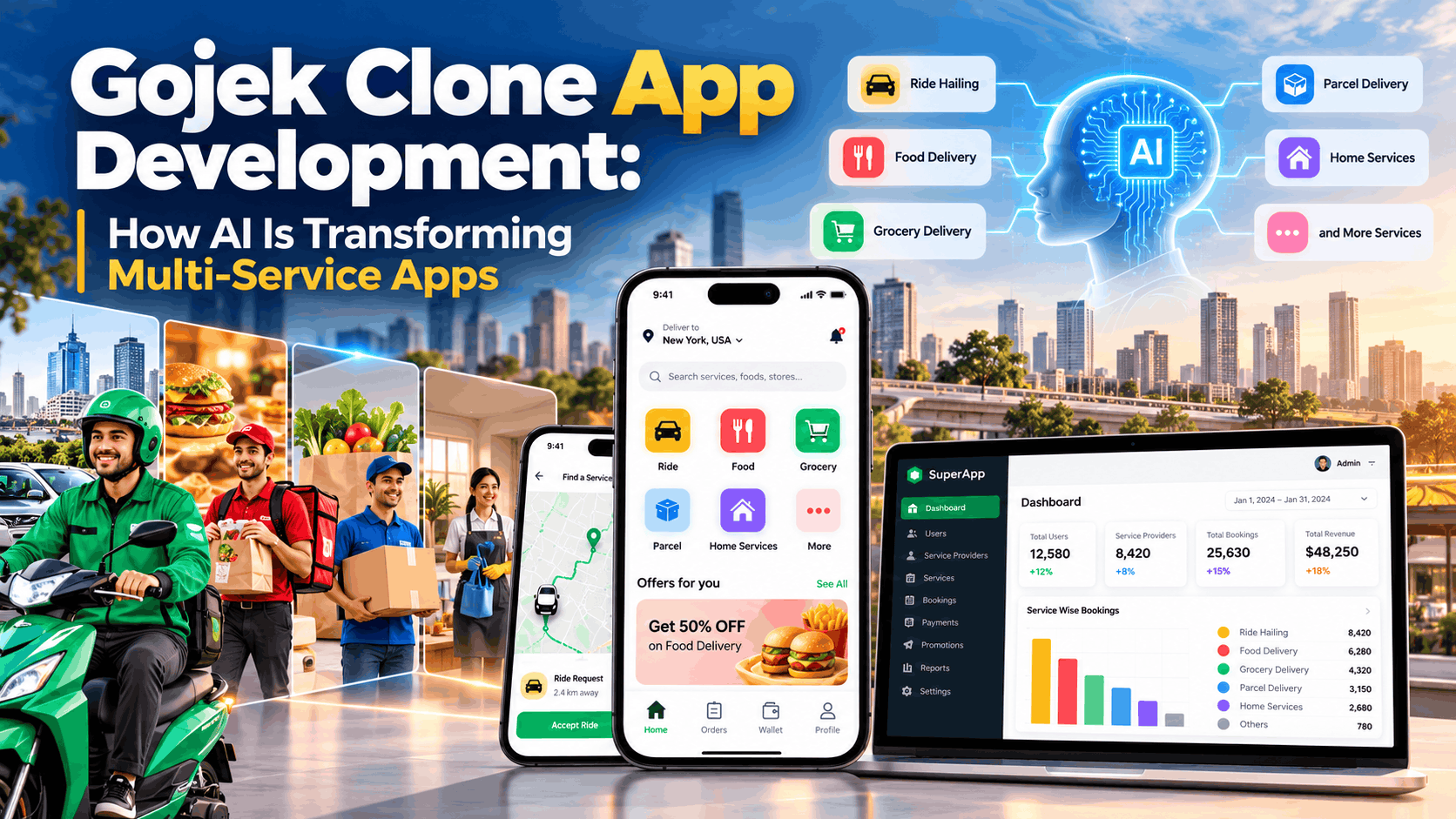
Gojek Clone App Development: How AI Is Transforming Multi-Service Apps
-
Customers increasingly expect digital platforms to handle multiple everyday needs through a single application. From booking rides and ordering food to purchasing groceries, sending parcels, and hiring professionals, convenience has become a major part of the digital service experience. This shift has created opportunities for entrepreneurs looking to build multi-service platforms inspired by successful super-app… Read More
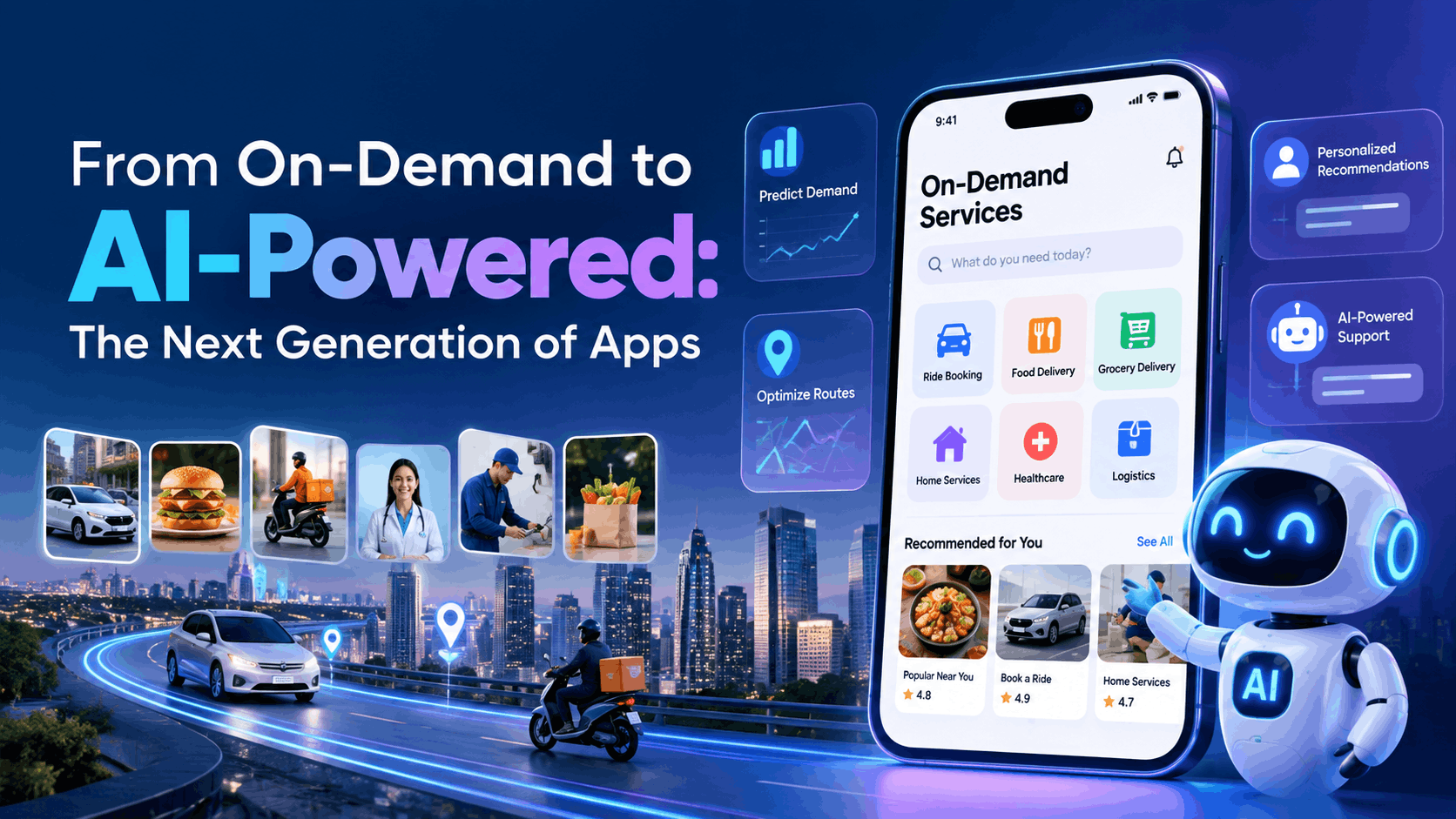
From On-Demand to AI-Powered: The Next Generation of Apps
-
On-demand apps have changed the way people access transportation, food, healthcare, home services, deliveries, and other everyday services. Customers can request what they need, track progress, make payments, and receive services through a single digital platform. But customer expectations are changing. People increasingly want faster responses, personalized recommendations, accurate updates, and smoother digital experiences. Businesses,… Read More
How to Choose an On Demand App Development Company for Your AI-Powered Business
-
Businesses across industries are moving toward on-demand services as customers increasingly expect convenience, speed, and personalized experiences. From food delivery and transportation to healthcare, home services, logistics, and grocery delivery, on-demand platforms are changing how businesses connect with their customers. The market is also becoming increasingly intelligent. The global AI in transportation market is estimated… Read More
Recent Posts
 Gojek Clone App Development: How AI Is Transforming Multi-Service Apps
 From On-Demand to AI-Powered: The Next Generation of Apps
 How to Choose an On Demand App Development Company for Your AI-Powered Business
 AI in Transportation: How Artificial Intelligence Is Transforming the Way We Move
 How Courier App Development Improves Delivery Operations