
From On-Demand to AI-Powered: The Next Generation of Apps
-
Ankit Patel
- October 02, 2026
- 8 min read
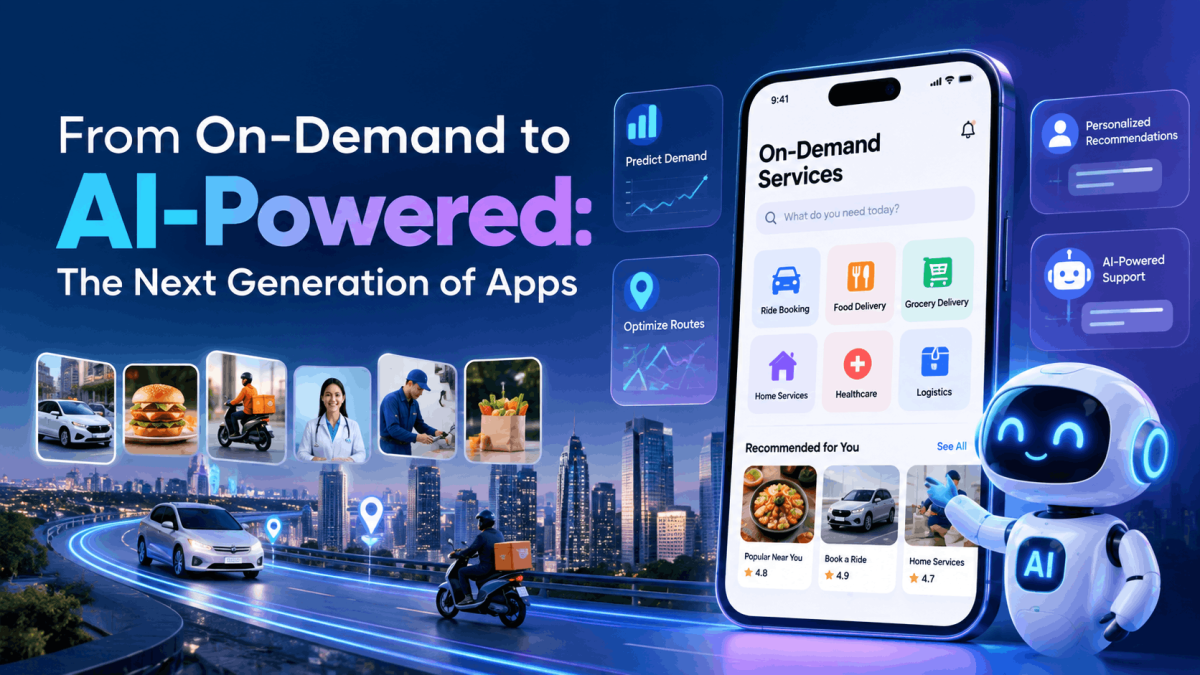
On-demand apps have changed the way people access transportation, food, healthcare, home services, deliveries, and other everyday services. Customers can request what they need, track progress, make payments, and receive services through a single digital platform.
But customer expectations are changing.
People increasingly want faster responses, personalized recommendations, accurate updates, and smoother digital experiences. Businesses, meanwhile, need better ways to predict demand, manage resources, automate repetitive tasks, and make data-driven decisions.
This shift is creating new opportunities for AI on demand app development. By combining artificial intelligence with on-demand technology, businesses can move beyond applications that simply respond to requests and build platforms that can analyze information, identify patterns, predict demand, automate workflows, and support smarter decisions.
The Shift From On-Demand to AI-Powered Apps
Traditional on-demand applications generally follow a straightforward process: a customer requests a service, the platform processes the request, a suitable provider is assigned, and the service is completed.
That model still works, but AI can make each stage more intelligent.
An AI-powered platform can analyze customer behavior, location, historical transactions, service availability, traffic conditions, and other data to support better decisions.
The market opportunity is also growing. The global artificial intelligence in transportation market is projected to increase from $4.27 billion in 2025 to $5.16 billion in 2026, with the market forecast to reach $10.8 billion by 2030 at a projected CAGR of 20.3% from 2026 to 2030.
For businesses building transportation, delivery, logistics, and mobility applications, this growth reflects increasing investment in AI-enabled services.
Instead of simply assigning the nearest available driver, for example, an intelligent system could consider estimated travel time, driver availability, customer preferences, traffic conditions, and historical demand when supporting the matching process.
The application becomes more than a transaction platform. It becomes an intelligent layer connecting customers, service providers, and business operations.
What Is an AI-Powered On-Demand App?
An AI powered on demand app combines conventional on-demand functionality with artificial intelligence, machine learning, predictive analytics, automation, or other intelligent technologies.
The application can collect information from different sources and use it to improve decisions and user experiences.
Depending on the business model, AI can support:
- Intelligent service matching
- Demand forecasting
- Personalized recommendations
- Route optimization
- Predictive maintenance
- Automated customer support
- Fraud detection
- Pricing analysis
- Customer behavior analysis
- Smart notifications
- Operational analytics
The objective isn’t to add AI to every part of an application. Instead, businesses can identify specific areas where intelligent technology can solve a problem or improve an existing process.
Why Businesses Are Moving Toward AI On-Demand App Development
The demand for fast and convenient services is putting pressure on businesses to make their digital platforms more responsive.
A March 2026 A&M–CII study of 2,019 Indian consumers across 54 cities found that 77% of respondents expect delivery within two hours. The same report says India’s quick-commerce market reached ₹65,700 crore in GMV in FY25, nearly 24 times its 2022 level.
These figures illustrate the speed expectations businesses are dealing with, particularly in delivery and service-based markets.
For an on-demand platform, meeting these expectations requires more than a good-looking mobile application. Businesses need efficient matching, accurate delivery estimates, intelligent routing, reliable communication, and effective resource allocation.
This is one reason AI on demand app development is becoming relevant to businesses looking to build more responsive platforms.
AI can analyze historical and real-time information to help businesses anticipate demand, understand customer preferences, and improve operational decisions.
Key AI Features Transforming On-Demand Apps
1. Intelligent Service Matching
Matching customers with the right provider is central to many on-demand platforms.
AI can evaluate factors such as location, availability, service type, historical performance, ratings, and estimated response time to support more intelligent matching.
For example, a home-service application could use these signals to identify professionals who are not only nearby but also have the appropriate skills and availability for a particular request.
2. AI-Based Demand Forecasting
Demand can change according to time, location, season, weather, events, and customer behavior.
AI-powered forecasting can analyze historical and real-time information to identify potential demand patterns.
A transportation platform, for example, could anticipate increased demand around business districts during peak hours. A food delivery platform could identify periods when certain locations are likely to receive more orders.
Businesses can use these insights to plan staffing, vehicle availability, inventory, and service capacity.
3. Personalized Recommendations
Personalization is another area where AI can improve on-demand experiences.
An AI system can analyze previous interactions, purchase history, preferences, location, and other relevant signals to recommend products or services that may be more useful to an individual customer.
For example, a grocery application could recommend frequently purchased products, while a food delivery platform could highlight restaurants or meals based on previous orders.
4. AI Route Optimization
Route planning is particularly important for transportation and delivery businesses.
AI can analyze traffic conditions, delivery locations, travel history, vehicle availability, and other variables to support more efficient routing.
The OECD notes that AI-driven route optimization can use real-time traffic, weather, and delivery requirements to improve logistics planning compared with static routes and fixed schedules.
This can be especially valuable when businesses manage large numbers of vehicles or deliveries simultaneously.
5. AI-Powered Customer Support
Customer support can consume significant operational resources when every question requires manual attention.
AI chatbots and virtual assistants can handle common questions about bookings, payments, cancellations, order status, service availability, and account information.
More complex cases can still be transferred to human support teams.
This creates a hybrid approach where AI handles routine interactions while employees focus on issues requiring human judgment.
6. Predictive Analytics and Maintenance
AI can also help businesses understand operational performance.
For transportation and fleet-based businesses, predictive maintenance can analyze sensor data, vehicle performance, and historical maintenance information to identify potential problems before failures occur.
The OECD cites Maersk as an example where predictive capabilities have helped cut maintenance costs by up to 20%, while improving fleet reliability and maintenance planning. This is a company-specific example rather than a universal industry result.
For an on-demand business, reducing unexpected downtime can help maintain service availability and minimize operational disruption.
Industries Benefiting From AI-Powered On-Demand Apps
AI-powered on-demand applications aren’t limited to a single industry.
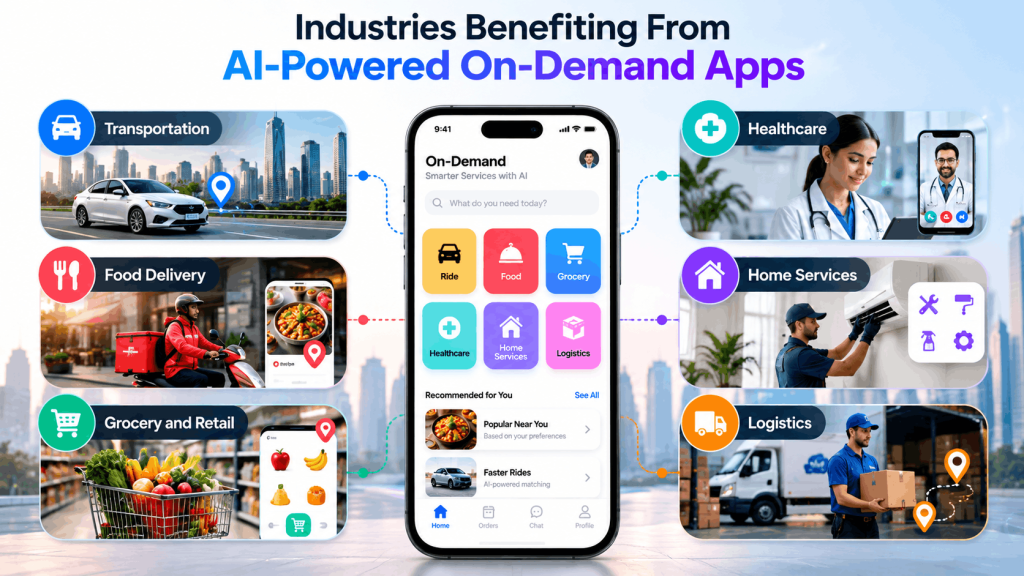
– Transportation
AI can support driver matching, demand prediction, route optimization, safety monitoring, and personalized travel experiences.
– Food Delivery
Food delivery platforms can use AI for restaurant recommendations, demand forecasting, delivery optimization, customer segmentation, and automated support.
– Healthcare
Healthcare applications can use AI for appointment workflows, patient communication, service matching, and other digital processes, depending on the application and applicable regulations.
– Home Services
Cleaning, repair, maintenance, beauty, and other home-service platforms can use AI to match customers with appropriate professionals and forecast service demand.
– Logistics
Logistics platforms can apply AI to route planning, fleet management, delivery forecasting, inventory analysis, and operational analytics.
– Grocery and Retail
AI can support product recommendations, inventory forecasting, personalized offers, and delivery planning.
Benefits of On-Demand App Development With AI
The biggest advantage of on demand app development with AIis that intelligence can be introduced into both customer-facing and operational processes.
• Better Customer Experiences
Personalized recommendations, faster matching, real-time updates, and automated assistance can reduce friction throughout the customer journey.
• Improved Operational Efficiency
AI can help businesses identify opportunities to improve resource utilization, scheduling, routing, and service delivery.
• Data-Driven Decisions
Instead of relying entirely on assumptions or manually prepared reports, businesses can use historical and real-time data to support operational decisions.
• More Predictive Operations
Traditional systems often respond after something happens. AI can help businesses anticipate demand, potential service issues, and changing customer behavior.
• Greater Scalability
Automation can help businesses handle growing transaction volumes while reducing the need for every routine process to be managed manually.
The Growing Intelligent Transportation Opportunity
The wider intelligent transportation market also provides context for this shift.
The global intelligent transportation systems market was valued at approximately $42.55 billion in 2025 and is projected to reach $55.36 billion by 2030, growing at a 5.4% CAGR. The market includes areas such as advanced traffic management, smart ticketing, tolling and parking systems, security, and traveler information.
This broader market growth demonstrates how transportation is moving toward connected systems that combine real-time data, automation, AI, and other technologies.
For businesses developing mobility, delivery, or logistics platforms, building an application with future AI capabilities can therefore be part of a longer-term technology strategy.
How to Build an AI-Powered On-Demand App
Successful AI on demand app development should begin with the business problem rather than the technology.
First, identify which parts of the customer journey or business operation can genuinely benefit from AI.
Next, define the required application features, data sources, integrations, infrastructure, and AI capabilities.
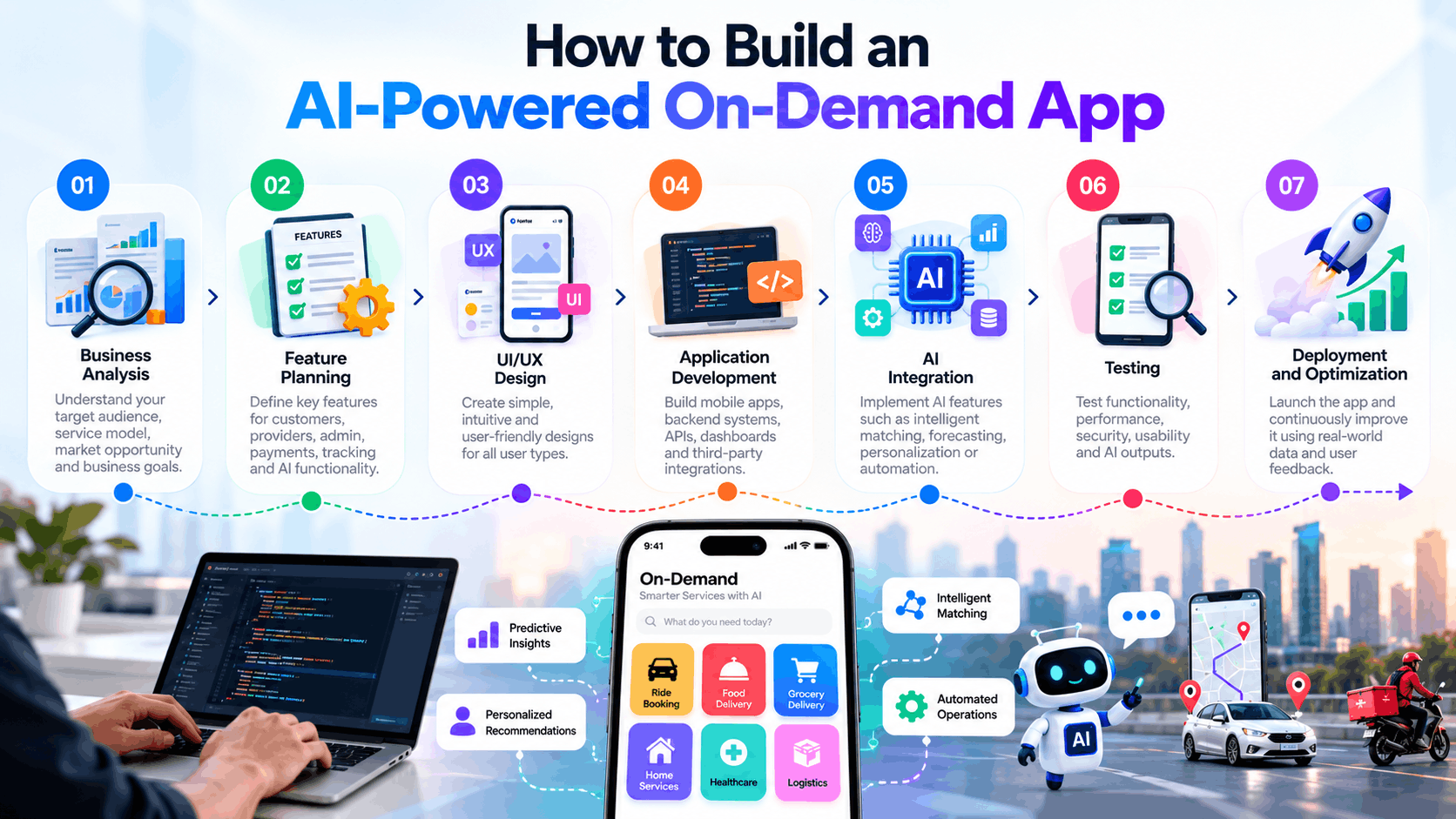
A typical development process can include:
1. Business analysis
Understand the target audience, service model, operational requirements, and market opportunity.
2. Feature planning
Define customer, provider, admin, payment, tracking, analytics, and AI functionality.
3. UI/UX design
Create simple and practical experiences for each user group.
4. Application development
Build the mobile applications, backend, APIs, dashboards, and integrations.
5. AI integration
Implement relevant capabilities such as recommendations, forecasting, matching, automation, or conversational AI.
6. Testing
Test functionality, performance, security, usability, and AI outputs.
7. Deployment and optimization
Launch the platform and improve it using real-world data and user feedback.
This phased approach can help businesses avoid spending resources on AI features that don’t address a genuine customer or operational need.
Choosing an AI On-Demand App Development Company
Selecting the right AI on demand app development company is an important part of the project.
A company that builds mobile applications may not necessarily have the experience required for AI-driven workflows, predictive analytics, real-time systems, or intelligent automation.
When evaluating potential development partners, consider their:
- AI and machine learning expertise
- Mobile and web development capabilities
- Backend and cloud experience
- API and third-party integration skills
- UI/UX design process
- Data security practices
- Scalability approach
- Testing methodology
- Post-launch support
Also ask how the company plans to collect, manage, protect, and use application data. AI features depend heavily on the quality and availability of the data supporting them.
What Does AI On-Demand App Development Cost?
There is no universal AI development cost because each application has different requirements.
The total investment can depend on:
- Number of platforms
- Feature complexity
- AI functionality
- UI/UX requirements
- Backend architecture
- Third-party integrations
- Cloud infrastructure
- Payment systems
- Real-time tracking
- Security requirements
- Development team location
- Maintenance and support
A basic MVP with one or two focused AI capabilities will require a different investment from a multi-service platform with advanced machine learning, real-time analytics, and multiple applications.
For this reason, businesses should define an MVP first and then create a roadmap for additional AI capabilities.
The Future of AI-Powered On-Demand Apps
The next generation of on-demand applications will focus less on simply processing requests and more on anticipating customer and business needs.
AI can help applications become more predictive, personalized, automated, and responsive.
Instead of waiting for customers to search for a service, future platforms may use relevant behavioral and contextual information to anticipate potential requirements. Instead of manually responding to changing demand, businesses can use predictive systems to prepare resources in advance.
However, AI won’t automatically make every application better. Its value depends on the quality of the underlying data, the relevance of the use case, system design, and how well the technology fits the business workflow.
That makes thoughtful AI on demand app development more important than simply adding AI features to an existing application.
Frequently Asked Questions
As businesses move toward smarter digital services, questions around AI on demand app development, features, costs, and implementation are becoming increasingly common. Below, we’ve answered some of the most important questions about AI-powered on-demand applications, from how they work and where they can be used to choosing the right development approach for your business.
AI on-demand app development involves creating on-demand applications that use artificial intelligence to improve services, automate processes, analyze data, personalize experiences, and support business decisions.
Common features include intelligent matching, demand forecasting, personalized recommendations, route optimization, AI chatbots, predictive analytics, fraud detection, automated workflows, and smart notifications.
Transportation, food delivery, healthcare, logistics, grocery, home services, retail, and other service-based industries can use AI-powered on-demand applications.
Evaluate the company’s experience with AI, mobile and backend development, real-time systems, integrations, security, scalability, UI/UX, and post-launch support. Experience with similar business models can also be valuable.
No. AI should be introduced where it addresses a genuine customer or business problem. Starting with a focused MVP and expanding AI capabilities based on measurable requirements can be a practical approach.
Final Thoughts
The move from traditional on-demand applications to intelligent platforms is changing how digital services are designed and delivered.
Market growth, increasing customer expectations, and advances in AI are creating opportunities for businesses to build applications that can do more than process bookings and transactions. They can predict demand, personalize experiences, optimize operations, and automate repetitive processes.
For businesses considering AI on demand app development, the priority should be identifying meaningful use cases rather than adding AI simply because it is a growing technology trend.
With the right product strategy, scalable architecture, quality data, and experienced development partner, an AI powered on demand app can become more than a digital marketplace. It can become an intelligent platform capable of adapting to changing customer needs and business conditions.

Ankit Patel is the Project Delivery Head at XongoLab Technologies LLP and PeppyOcean, leading mobile app development companies specializing in custom software & mobile app solutions. Passionate about technology and innovation, he enjoys writing about mobile & software development, business, and marketing. His articles have been featured on renowned publications, including YourStory, E27, Datafloq, JaxEnter, TechTarget, Adobe, DesignWebKit, InstantShift, Business Magazine, Simple Programmer, and many others.
You may also like

How to Choose an On Demand App Development Company for Your AI-Powered Business
-
Businesses across industries are moving toward on-demand services as customers increasingly expect convenience, speed, and personalized experiences. From food delivery and transportation to healthcare, home services, logistics, and grocery delivery, on-demand platforms are changing how businesses connect with their customers. The market is also becoming increasingly intelligent. The global AI in transportation market is estimated… Read More
AI in Transportation: How Artificial Intelligence Is Transforming the Way We Move
-
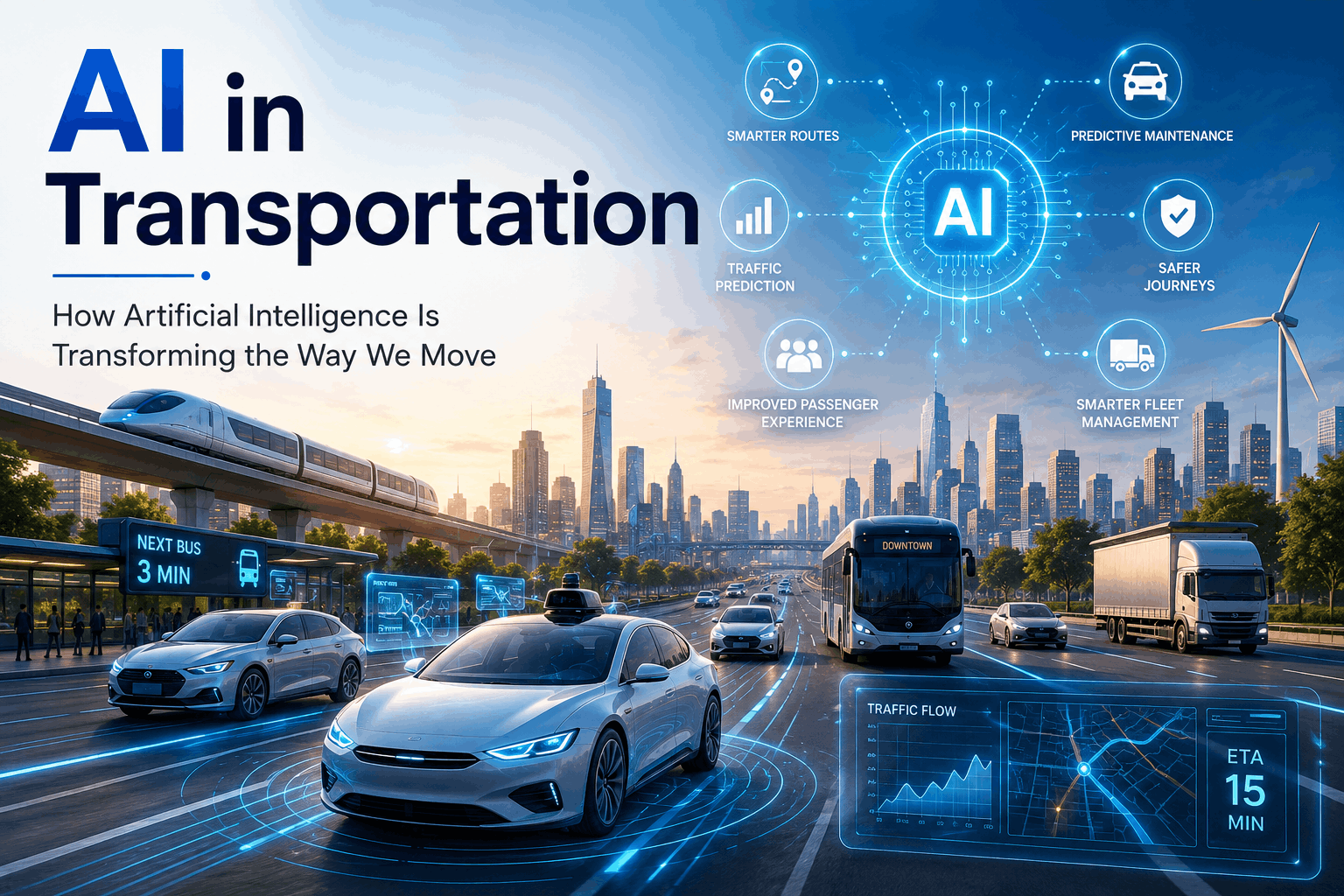
Transportation has always evolved alongside technology. From steam-powered trains to electric vehicles and GPS navigation, every major innovation has changed how people and goods move from one place to another. Today, AI in transportation is becoming another major turning point. Artificial intelligence is helping transportation companies make faster decisions, understand changing travel patterns, improve fleet… Read More
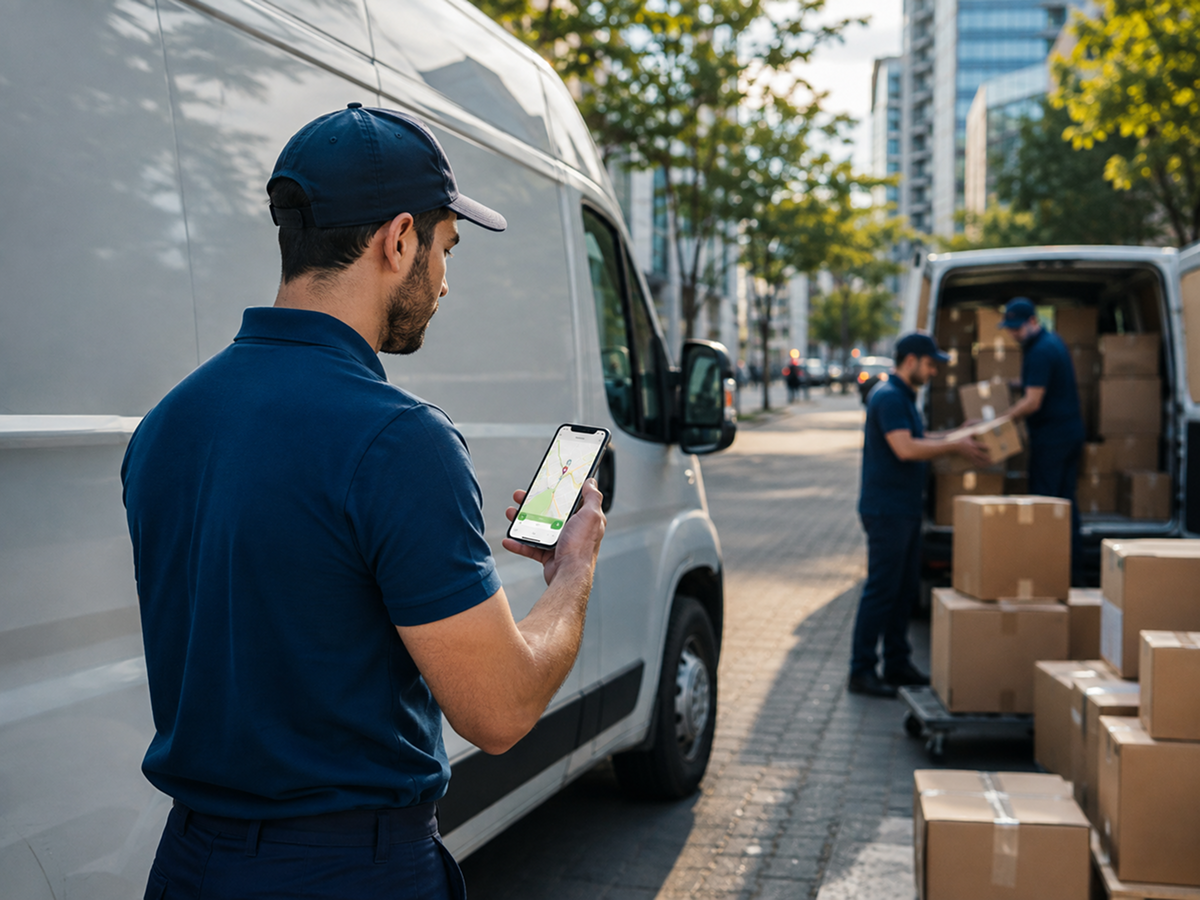
How Courier App Development Improves Delivery Operations
-
A customer places an order and expects one thing: the package should arrive when promised. Behind that simple expectation, courier businesses have to coordinate orders, drivers, routes, payments, tracking, customer updates, and delivery schedules every day. As delivery volumes grow, managing these activities through spreadsheets, phone calls, or disconnected systems becomes difficult. A small delay… Read More
Free Consultation!
Please fill the form below and one of our technical associate will get in touch with you shortly.
Recent Posts
 From On-Demand to AI-Powered: The Next Generation of Apps
 How to Choose an On Demand App Development Company for Your AI-Powered Business
 AI in Transportation: How Artificial Intelligence Is Transforming the Way We Move
 How Courier App Development Improves Delivery Operations
 How AI Can Improve Your Food Delivery App with Intelligent Automation
Categories
- AI Food Delivery App
- AI Taxi App
- AI transportation app
- Artificial Intelligence
- Food Delivery App
- Mobile Apps Development
- on demand app development company
- On Demand Apps
- On Demand Courier Delivery
- On Demand Electrician
- On Demand Flower Delivery
- On Demand Food Ordering
- On Demand Grocery Delivery
- On Demand Handyman
- On Demand Laundry
- On Demand Medicine Delivery
- On Demand Transport & Logistics
- Software Development
- Taxi Booking
- Uber Like App Clone
Keeping a close tab on upcoming advanced technologies, PeppyOean' team creates every solution which matches the latest technology standards. Crafting each and every solution as per the unique requirement of our clients, we have successfully emerged as a number one on demand mobile app development company across the world.


© 2026 - PeppyOcean. All Rights Are Reserved
The use of the terms “Uber” or “Gojek” or any other name is purely to elucidate the details of our services. We declare our non-association Uber Technologies Inc. or Gojek or any other Organization in any way. Our main aim is to help the end-user understand the nature of our services and our intentions are harmless for any organization.