
How AI Can Improve Your Food Delivery App with Intelligent Automation
-
Ankit Patel
- August 04, 2026
- 10 min read
The online food delivery industry has experienced tremendous growth over the past decade. Customers now expect more than just a platform to place food orders—they demand personalized recommendations, lightning-fast deliveries, real-time tracking, accurate ETAs, seamless customer support, and an overall hassle-free experience. As competition continues to grow, simply having a Food Delivery App is no longer enough to attract and retain customers.
This is where Artificial Intelligence (AI) is transforming the industry. Businesses are no longer using AI as an experimental technology but as a strategic tool to automate operations, improve decision-making, and enhance customer satisfaction. Whether you operate a restaurant delivery platform, a cloud kitchen, or a multi-vendor marketplace, integrating AI in Food Delivery App solutions can significantly improve efficiency while increasing customer retention and revenue.
Instead of investing in an entirely new application, many businesses are choosing to upgrade their Food Delivery App with intelligent automation. AI-powered capabilities such as personalized food recommendations, smart order management, predictive demand forecasting, AI route optimization, chatbot support, and delivery automation help businesses streamline operations while delivering a superior customer experience.
If your food ordering platform is already live, upgrading it with AI is one of the smartest investments you can make to future-proof your business and stay ahead of the competition.
Why Traditional Food Delivery Apps Are No Longer Enough
A few years ago, offering online ordering and delivery was enough to stand out in the market. Today, customer expectations have changed dramatically. People expect food delivery apps to understand their preferences, provide instant updates, recommend meals they are likely to order, and ensure deliveries arrive as quickly as possible.
Unfortunately, many traditional food delivery applications still rely on manual processes and static workflows that limit business growth.
Some common challenges include:
• Delayed order processing during peak hours • Inefficient delivery partner allocation • Longer delivery times • Poor customer engagement • Limited personalization • High order cancellation rates • Increased customer support workload • Difficulty predicting customer demand • Inefficient delivery route planning • Limited operational insights
These issues don’t just affect customer satisfaction—they directly impact repeat orders, operational costs, and overall profitability.
Instead of rebuilding the platform from scratch, businesses can integrate AI Food Delivery Features into their existing application to solve these challenges while making their operations more intelligent and scalable.
What Is an AI Food Delivery App?
An AI Food Delivery App is an advanced version of a traditional food ordering application that uses artificial intelligence, machine learning, and predictive analytics to automate decision-making and optimize daily operations.
Unlike conventional applications that rely on predefined rules, AI continuously learns from customer behavior, order history, restaurant performance, delivery patterns, and real-time data. This allows the platform to make smarter decisions automatically and improve over time.
An AI-powered food delivery app can:
• Recommend meals based on customer preferences • Predict food demand during peak hours • Assign delivery partners intelligently • Optimize delivery routes in real time • Provide accurate delivery estimates • Automate customer support with AI chatbots • Detect fraudulent transactions • Analyze customer buying patterns • Improve restaurant and delivery partner efficiency
The result is a faster, smarter, and more personalized experience for customers while helping businesses reduce operational costs and increase revenue.
Why Upgrade Your Existing Food Delivery App Instead of Building a New One?
Many businesses believe adopting AI requires developing a completely new application. In reality, most AI capabilities can be integrated into your existing platform without disrupting current operations.
Upgrading your current app offers several advantages.
1. Cost-Effective Modernization Developing a new platform from scratch requires significant investment in design, development, testing, and deployment. Integrating AI into your existing app allows you to enhance its capabilities while reducing development costs.
2. Faster Time to Market Since your application is already operational, adding AI-powered modules takes considerably less time than rebuilding the entire platform. This enables you to introduce innovative features quickly and stay competitive.
3. Better Customer Retention Your existing customers can continue using the same application while benefiting from intelligent improvements such as personalized recommendations, faster deliveries, and improved support. This minimizes disruption and encourages long-term loyalty.
4. Higher Return on Investment AI enhances every stage of the food delivery journey—from order placement to final delivery. Better operational efficiency, reduced cancellations, optimized deliveries, and improved customer experiences ultimately lead to increased orders and higher revenue.
Traditional Food Delivery App vs. AI-Powered Food Delivery App
The difference between a conventional application and an AI-powered platform is much more than advanced technology. It represents a shift from reactive operations to intelligent automation.
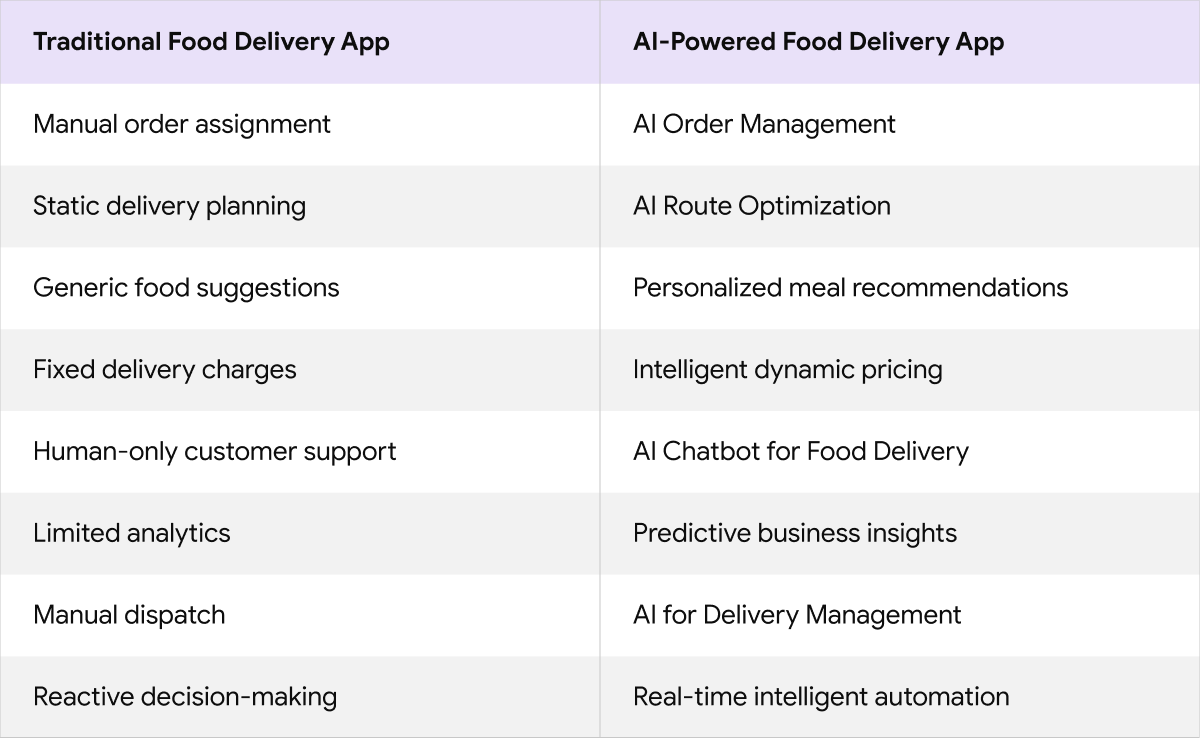
Businesses that embrace intelligent automation gain a significant competitive advantage by improving operational efficiency, reducing costs, and delivering a superior customer experience.
AI Is More Than Automation—It’s a Growth Engine
Many businesses assume AI simply automates repetitive tasks. While automation is one of its biggest advantages, the real value lies in AI’s ability to make smarter business decisions.
For example, AI can analyze customer ordering behavior to recommend dishes they are most likely to purchase, increasing average order value. It can predict demand before peak hours, helping restaurants prepare inventory and delivery partners in advance. AI also enables businesses to optimize delivery routes, reducing travel time, fuel costs, and late deliveries.
By turning real-time data into actionable insights, AI empowers food delivery businesses to improve efficiency, enhance customer satisfaction, and unlock sustainable growth.
Top 10 AI Features That Can Transform Your Food Delivery App
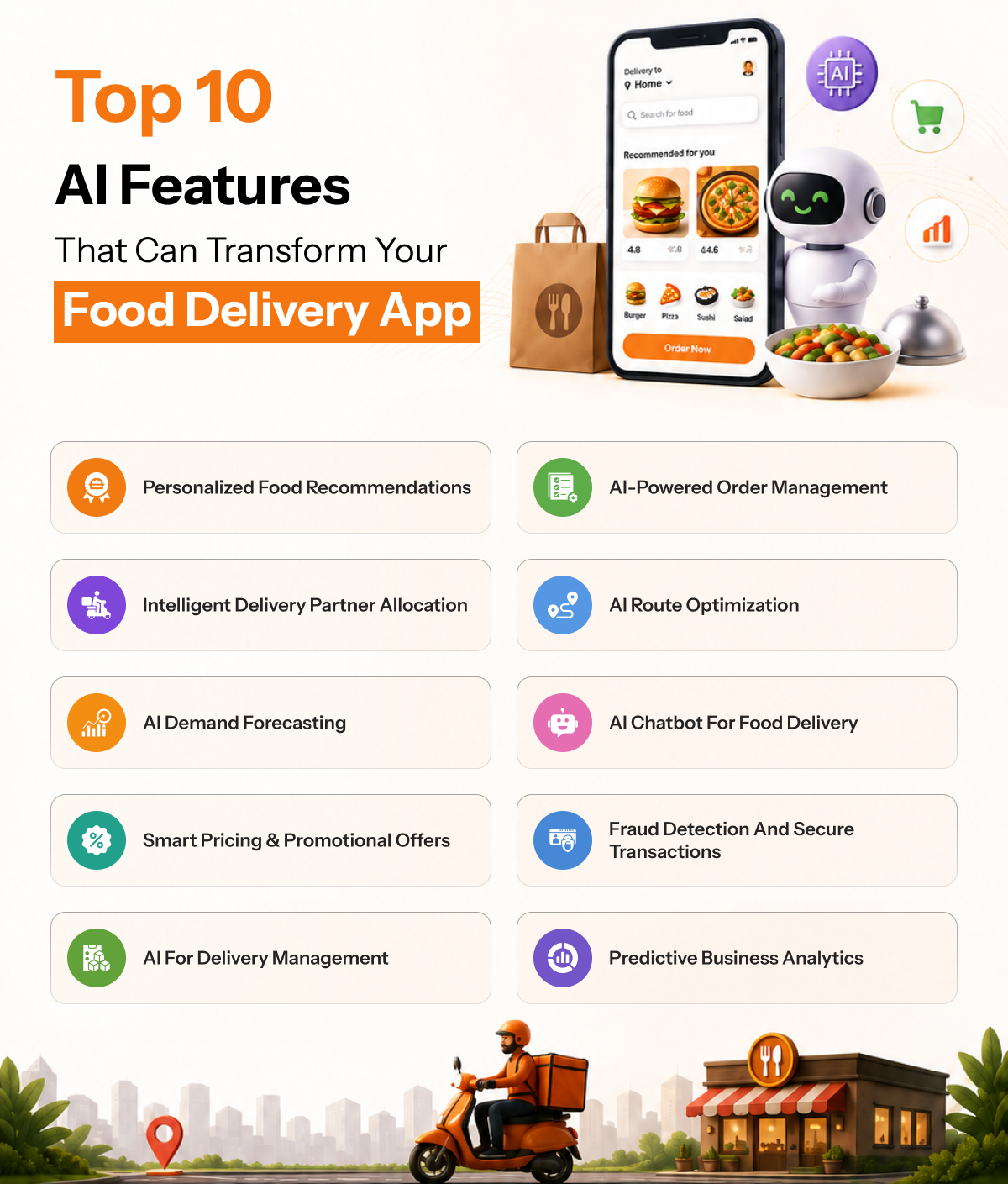
Artificial intelligence is changing the way food delivery businesses operate. From automating repetitive tasks to improving customer experiences and delivery efficiency, AI enables businesses to make smarter decisions using real-time data. Whether you run a restaurant delivery platform, a cloud kitchen app, or a multi-restaurant marketplace, integrating the right AI Food Delivery Features can help you increase orders, reduce operational costs, and improve customer loyalty.
Here are ten powerful AI features that can transform your existing Food Delivery App into an intelligent, revenue-generating platform.
1. Personalized Food Recommendations One of the biggest advantages of an AI Food Delivery App is its ability to understand customer preferences. AI analyzes previous orders, browsing history, favorite cuisines, dietary preferences, and ordering patterns to recommend meals that customers are more likely to purchase.
Instead of showing the same menu to every user, AI creates a personalized experience for each customer. This not only improves user engagement but also encourages repeat orders and increases the average order value through intelligent upselling and cross-selling.
2. AI-Powered Order Management Managing hundreds or even thousands of daily orders manually can lead to delays and operational errors. AI Order Management automates order processing by intelligently assigning orders, prioritizing urgent deliveries, and coordinating communication between restaurants and delivery partners.
This reduces processing time, minimizes mistakes, and ensures orders move smoothly through every stage of the delivery process. Faster order handling directly contributes to improved customer satisfaction and higher operational efficiency.
3. Intelligent Delivery Partner Allocation Assigning the nearest delivery partner doesn’t always guarantee the fastest delivery. AI evaluates multiple factors such as current traffic conditions, delivery partner availability, order priority, vehicle type, and delivery distance before assigning an order.
This intelligent allocation improves delivery speed, reduces idle time for delivery partners, and allows businesses to complete more deliveries without increasing fleet size.
4. AI Route Optimization
Traffic congestion can negatively impact customer satisfaction, fuel costs, and driver productivity.
AI continuously evaluates live traffic conditions, accidents, road closures, and travel patterns to recommend the fastest and most efficient routes.
Benefits include:
• Faster pickups • Lower fuel consumption • Reduced delivery costs • Better ETA accuracy • Higher customer satisfaction • Increased deliveries per rider
Efficient route planning also enables delivery partners to complete more orders during peak hours, directly contributing to higher revenue.
5. AI Demand Forecasting
Customer demand changes based on weather conditions, weekends, holidays, festivals, local events, and promotional campaigns. AI studies historical and real-time data to accurately predict demand before it occurs.
This helps businesses:
• Prepare restaurant inventory • Schedule delivery partners efficiently • Reduce food waste • Handle peak-hour traffic smoothly • Improve order fulfillment
For restaurants and cloud kitchens, predictive analytics can significantly reduce operational inefficiencies while improving profitability.
6. AI Chatbot for Food Delivery
Customers frequently ask questions regarding order status, payment issues, refunds, delivery times, cancellations, and restaurant availability. Handling these queries manually increases support costs and response times.
An AI Chatbot for Food Delivery provides instant assistance 24/7, resolving common customer queries within seconds. It can also help customers place orders, modify deliveries, recommend restaurants, and provide real-time tracking updates.
This improves customer satisfaction while allowing support teams to focus on more complex issues.
7. Smart Pricing and Promotional Offers
Every customer has different purchasing habits. AI analyzes customer behavior, ordering frequency, preferred cuisines, and spending patterns to create personalized discounts and promotional campaigns.
Instead of offering the same coupon to every customer, AI can generate targeted offers that increase conversion rates and customer retention.
Businesses can also use AI to optimize delivery charges based on factors such as demand, delivery distance, weather conditions, and rider availability, ensuring profitability without negatively affecting the customer experience.
8. Fraud Detection and Secure Transactions
Food delivery platforms process thousands of digital payments every day, making them vulnerable to fraudulent activities. AI continuously monitors transaction patterns to identify suspicious behavior before it causes financial losses.
Artificial intelligence can detect:
• Fake customer accounts • Payment fraud • Coupon abuse • Duplicate orders • Unusual purchasing behavior • Account takeover attempts
By reducing fraudulent transactions, businesses protect both customers and restaurant partners while maintaining platform trust.
9. AI for Delivery Management
One of the most valuable applications of artificial intelligence is AI for Delivery Management. Instead of manually coordinating deliveries, AI automates dispatching, monitors delivery partner performance, predicts delays, and optimizes fleet utilization.
With intelligent delivery management, businesses can:
• Improve rider productivity • Reduce delivery delays • Increase successful deliveries • Optimize driver schedules • Monitor real-time delivery performance • Improve customer satisfaction
This creates a more reliable and scalable delivery ecosystem while lowering operational costs
10. Predictive Business Analytics
Successful food delivery businesses rely on data-driven decisions rather than assumptions. AI converts large volumes of operational data into meaningful business insights that help owners identify growth opportunities.
With predictive analytics, businesses can answer important questions such as:
• Which restaurants receive the most orders? • What cuisines are trending? • Which locations generate the highest revenue? • When should more delivery partners be deployed? • Which marketing campaigns deliver the best ROI? • Why are customers abandoning their carts?
These insights help businesses make smarter strategic decisions that drive long-term growth.
How AI Benefits Every Stakeholder
The true power of intelligent automation lies in its ability to create value for everyone involved in the food delivery ecosystem.
For Customers
Customers enjoy faster deliveries, personalized food recommendations, accurate ETAs, seamless order tracking, secure payments, and instant support. These improvements lead to a more convenient and satisfying ordering experience, encouraging repeat purchases.
For Restaurant Partners Restaurants benefit from better order management, improved demand forecasting, reduced food waste, optimized inventory planning, and higher order volumes. AI also helps identify popular menu items and customer preferences, enabling restaurants to make informed business decisions.
For Delivery Partners Delivery personnel experience smarter order allocation, optimized routes, reduced idle time, and better earning opportunities. AI minimizes unnecessary travel and ensures riders receive orders that maximize efficiency.
For Business Owners For food delivery platform owners, AI means lower operational costs, improved delivery efficiency, better customer retention, higher average order values, increased order volumes, and stronger profitability. By automating routine processes and leveraging predictive analytics, businesses can scale more effectively while maintaining excellent service quality.
How to Upgrade Your Existing Food Delivery App with AI
Adding AI to your platform requires careful planning rather than simply integrating new features. A successful AI implementation begins with understanding your business challenges and identifying where intelligent automation can create the biggest impact.
1. Evaluate Your Existing Platform
Start by analyzing your current application and identifying operational bottlenecks. Ask yourself questions like: • Are customers abandoning orders before checkout? • Are delivery times increasing during peak hours? • Is customer support receiving repetitive queries? • Are delivery partners facing inefficient route planning? • Are restaurants struggling to predict demand?
Understanding these pain points helps you prioritize AI features that deliver measurable business value.
2. Select AI Features That Match Your Business Goals
Every food delivery business operates differently. A cloud kitchen, restaurant chain, grocery delivery platform, and multi-restaurant marketplace all have unique operational requirements.
Choose AI capabilities based on your objectives, such as: • Personalized food recommendations to increase order value • AI Route Optimization for faster deliveries • AI Chatbot for Food Delivery to improve customer support • AI Demand Forecasting to manage peak-hour orders • AI Order Management to automate workflows • AI for Delivery Management to optimize rider performance
Implementing only the features that align with your business ensures maximum return on investment while keeping development efficient.
3. Train AI with Quality Data
Artificial intelligence delivers better results when it learns from reliable data. Historical order records, customer preferences, restaurant performance, delivery times, and rider activity enable AI to generate more accurate predictions and automate decisions effectively.
As your business grows, AI continuously improves by learning from new customer interactions and operational data.
4. Monitor Performance and Scale
AI is not a one-time upgrade—it becomes smarter over time. After implementation, monitor key performance indicators such as: • Order conversion rate • Average order value • Customer retention • Delivery time • Rider utilization • Restaurant performance • Customer satisfaction • Revenue growth
These insights allow businesses to optimize AI models continuously and unlock even greater operational efficiency.
Why Partner with an Experienced Food Delivery App Development Company?
Integrating AI into an existing application requires expertise in software architecture, artificial intelligence, cloud infrastructure, API integration, security, and mobile app development. Choosing the right Food Delivery App Development Company ensures your AI implementation is scalable, secure, and aligned with your long-term business objectives.
An experienced development partner can help you:
• Analyze your current application architecture • Identify the most valuable AI opportunities • Integrate AI without disrupting existing operations • Improve application performance • Ensure data security and compliance • Scale your platform as your business grows • Provide ongoing maintenance and AI enhancements
Rather than simply adding features, the right technology partner helps transform your platform into an intelligent business ecosystem.
Why Choose PeppyOcean for AI Food Delivery App Development?
At PeppyOcean, we help food delivery businesses embrace the power of AI through customized, scalable, and future-ready digital solutions. Whether you operate a restaurant delivery platform, cloud kitchen, grocery delivery app, or a multi-vendor marketplace, our AI experts can modernize your existing application with intelligent automation.
Our expertise includes:
• AI Food Delivery App Development • AI-powered Order Management • Personalized Recommendation Engines • AI Route Optimization • AI Chatbots for Customer Support • AI Demand Forecasting • Delivery Management Software • Smart Delivery Tracking • Restaurant Management Solutions • Custom AI Integration • Mobile App Modernization • AI Analytics & Business Intelligence
Our approach focuses on improving customer experiences, increasing operational efficiency, reducing costs, and helping businesses achieve sustainable growth through intelligent technology.
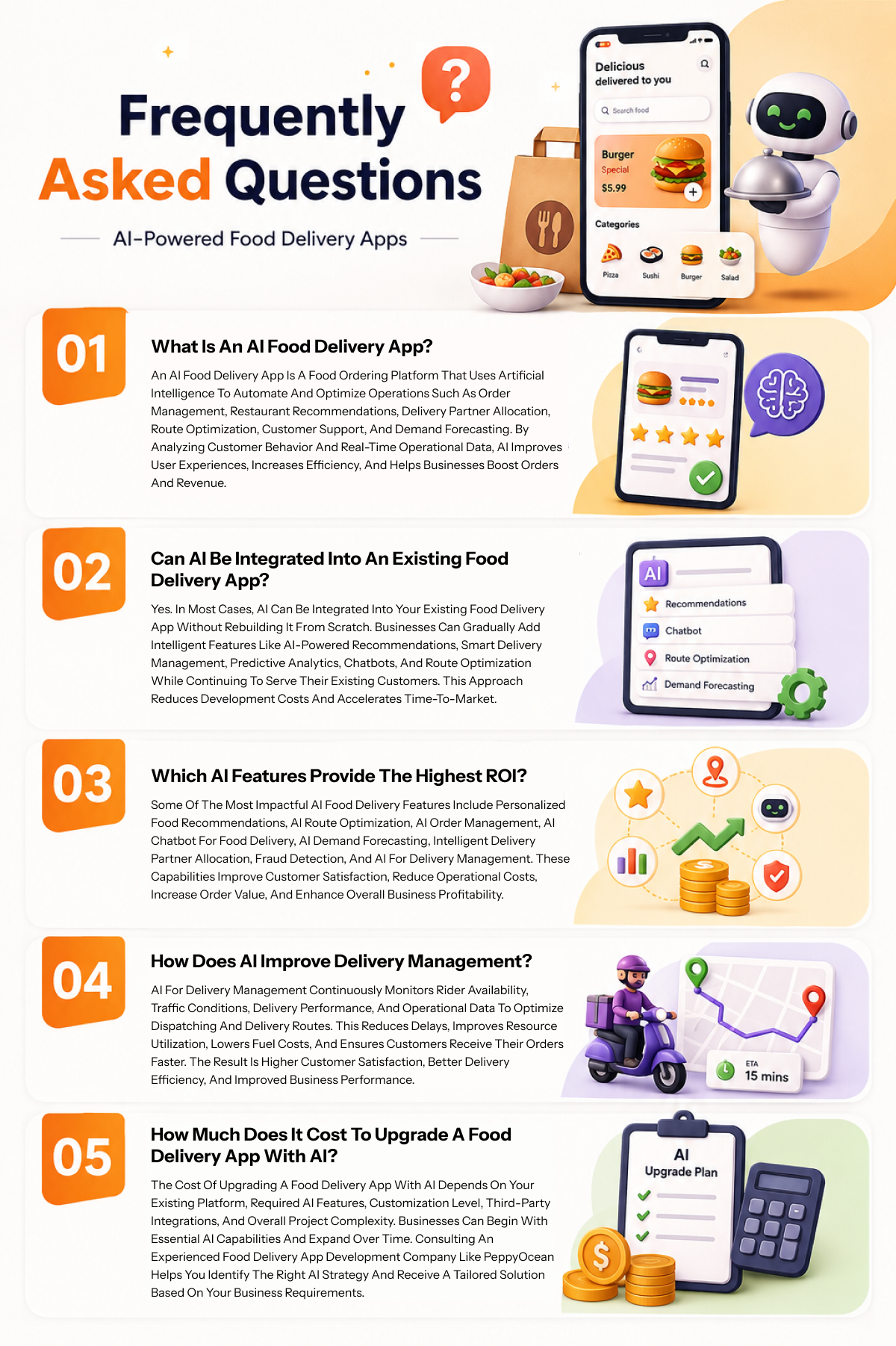
FAQs About AI Taxi App
Artificial intelligence is transforming the food delivery industry, but many business owners still have questions about how it works and the value it can bring to their existing platforms. Below, we’ve answered some of the most common questions related to AI-powered food delivery app development, intelligent automation, implementation, and the business benefits of upgrading your current application.
Final Verdict
Artificial intelligence is no longer a futuristic concept—it has become a practical business solution that is reshaping the food delivery industry. From personalized customer experiences and intelligent order management to optimized delivery routes and predictive analytics, AI helps businesses operate more efficiently while delivering better service to customers.
If your platform already has a solid customer base, you don’t need to replace it. Instead, you can upgrade your Food Delivery App with intelligent automation that improves operational performance, reduces costs, and creates new opportunities for revenue growth.
Businesses that adopt AI today will be better positioned to meet changing customer expectations, improve operational efficiency, and maintain a competitive advantage in the rapidly evolving food delivery market.
Transform Your Food Delivery App with PeppyOcean
If you’re planning to upgrade your existing Food Delivery App with intelligent AI capabilities, PeppyOcean is your trusted technology partner.
Our team specializes in developing scalable, AI-powered food delivery solutions that help restaurants, cloud kitchens, startups, and enterprise delivery platforms automate operations, improve customer engagement, optimize delivery management, and increase profitability.
Ready to future-proof your food delivery business? Contact PeppyOcean today and discover how AI can help you deliver faster, operate smarter, and grow your revenue. 🚀

Ankit Patel is the Project Delivery Head at XongoLab Technologies LLP and PeppyOcean, leading mobile app development companies specializing in custom software & mobile app solutions. Passionate about technology and innovation, he enjoys writing about mobile & software development, business, and marketing. His articles have been featured on renowned publications, including YourStory, E27, Datafloq, JaxEnter, TechTarget, Adobe, DesignWebKit, InstantShift, Business Magazine, Simple Programmer, and many others.
You may also like
How to Choose an On Demand App Development Company for Your AI-Powered Business
-
Businesses across industries are moving toward on-demand services as customers increasingly expect convenience, speed, and personalized experiences. From food delivery and transportation to healthcare, home services, logistics, and grocery delivery, on-demand platforms are changing how businesses connect with their customers. The market is also becoming increasingly intelligent. The global AI in transportation market is estimated… Read More
AI in Transportation: How Artificial Intelligence Is Transforming the Way We Move
-
Transportation has always evolved alongside technology. From steam-powered trains to electric vehicles and GPS navigation, every major innovation has changed how people and goods move from one place to another. Today, AI in transportation is becoming another major turning point. Artificial intelligence is helping transportation companies make faster decisions, understand changing travel patterns, improve fleet… Read More
How Courier App Development Improves Delivery Operations
-
A customer places an order and expects one thing: the package should arrive when promised. Behind that simple expectation, courier businesses have to coordinate orders, drivers, routes, payments, tracking, customer updates, and delivery schedules every day. As delivery volumes grow, managing these activities through spreadsheets, phone calls, or disconnected systems becomes difficult. A small delay… Read More
Recent Posts
 How to Choose an On Demand App Development Company for Your AI-Powered Business
 AI in Transportation: How Artificial Intelligence Is Transforming the Way We Move
 How Courier App Development Improves Delivery Operations
 How AI Can Improve Your Food Delivery App with Intelligent Automation
 How AI Can Upgrade Your Existing Taxi App to Increase Bookings and Revenue