
How AI Can Upgrade Your Existing Taxi App to Increase Bookings and Revenue

-
Ankit Patel
- July 24, 2026
- 10 min read
Launching a taxi booking app was once enough to stay competitive. Today, that’s no longer the case. The ride-hailing market has become increasingly competitive, with customers expecting faster bookings, accurate ETAs, seamless payments, and instant support. Businesses that continue to rely on traditional taxi apps often struggle to keep pace with these expectations.
AI is transforming how taxi businesses operate by making applications smarter, more efficient, and customer-centric. Instead of replacing your existing platform, AI enables you to upgrade your taxi app with intelligent capabilities that improve booking experiences, optimize fleet operations, and generate more revenue.
Whether you manage a local taxi fleet or operate a large ride-hailing platform, integrating AI into your taxi booking app can unlock new opportunities for growth. Features such as intelligent driver matching, dynamic pricing, AI-powered customer support, and route optimization allow businesses to deliver faster and more reliable services while maximizing profitability.
If your taxi application already has a strong user base, adding AI is one of the smartest investments you can make to future-proof your business.
Why Traditional Taxi Apps Are Losing Their Competitive Edge?
Many taxi businesses launched their apps several years ago when simply allowing users to book rides online was considered innovative. Today, that functionality has become the industry standard.
Modern customers expect much more than a booking interface. They want instant ride confirmations, minimal waiting times, transparent pricing, real-time updates, personalized recommendations, and responsive customer support.
Traditional taxi applications often struggle with:
• Inefficient driver allocation • Inefficient driver allocation • Higher ride cancellation rates • Manual fleet management • Static pricing regardless of demand • Limited customer engagement • Delayed support responses • Poor operational insights
These limitations can directly impact customer satisfaction, repeat bookings, and overall revenue.
Rather than rebuilding your application from scratch, many businesses now choose to upgrade their taxi app with AI-driven capabilities that enhance the existing platform while preserving its core functionality.
What Is an AI Taxi App?
An AI Taxi App is an intelligent version of a traditional taxi booking platform that uses artificial intelligence and machine learning to automate decisions, analyze data, and continuously improve operations.
Unlike conventional taxi applications that rely on fixed rules, AI-enabled platforms learn from user behavior, booking history, driver performance, traffic patterns, and market demand to deliver smarter recommendations and better operational efficiency.
An AI-powered taxi booking app can:
• Match passengers with the most suitable nearby drivers • Predict demand during peak hours • Optimize travel routes in real time • Estimate more accurate arrival times • Automate customer support using AI chatbots • Recommend personalized offers • Detect suspicious transactions and fraudulent activities • Improve driver productivity through intelligent dispatching
Why Upgrading Your Existing Taxi App Makes More Business Sense
Many business owners assume adopting AI means developing an entirely new application. In reality, most AI capabilities can be integrated into your current taxi platform.
Upgrading an existing taxi booking app offers several advantages:
1. Lower Development Costs Instead of investing in a completely new solution, AI modules can be integrated into your existing infrastructure, reducing development expenses while extending your app’s capabilities.
2. Faster Time to Market Since your application is already live, implementing AI features usually requires significantly less time than building a new platform from scratch.
3. Preserve Existing Customers Your current users can continue using the same application while gradually benefiting from new AI-powered improvements without any disruption.
4. Better Return on Investment Enhancing an existing taxi app allows businesses to generate additional revenue through improved operational efficiency, higher booking conversions, and better customer retention.
AI vs Traditional Taxi Booking Apps
The difference between a conventional taxi app and an AI-powered platform goes far beyond technology—it directly impacts business growth.
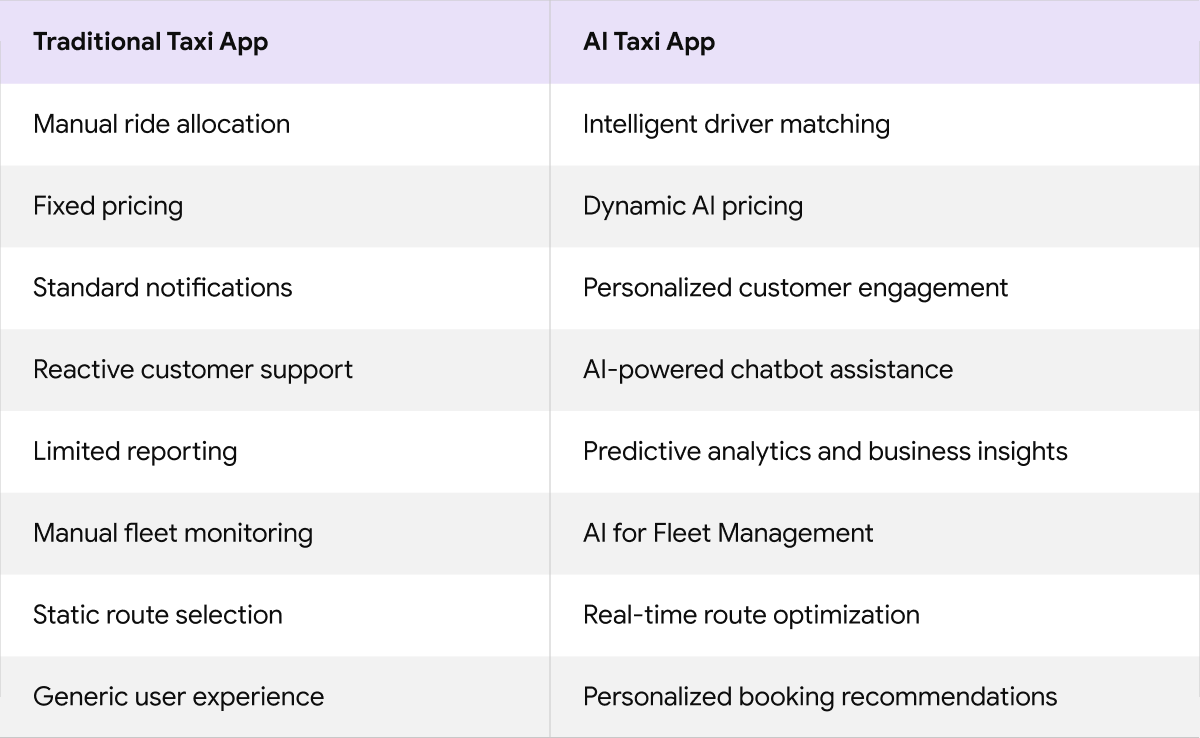
Businesses that invest in AI gain greater control over operations while providing customers with a faster, more convenient, and more reliable ride-booking experience.
Top 10 AI Taxi App Features That Increase Bookings and Revenue
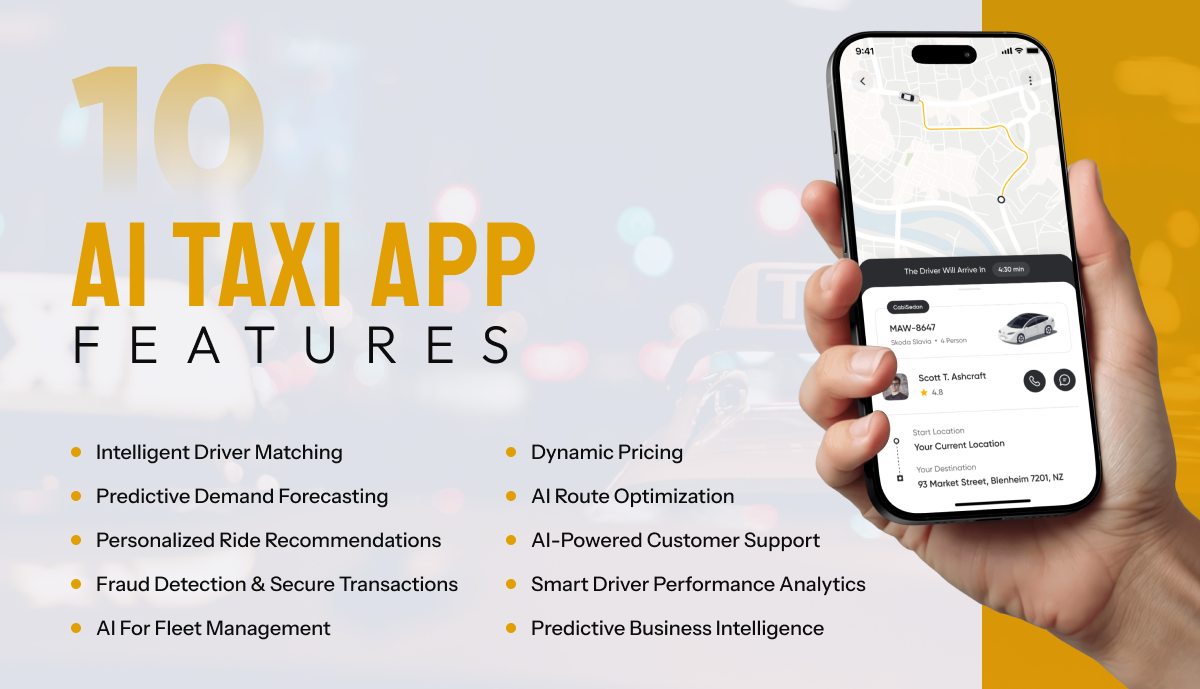
Integrating AI into your existing taxi booking app is about much more than adding new technology. It’s about creating a smarter business that can respond to customer needs faster, optimize operations automatically, and unlock new revenue opportunities.
Whether you operate a city-based taxi service, an airport transfer business, or a multi-location ride-hailing platform, the right AI Taxi App Features can significantly improve efficiency while delivering a better experience for both passengers and drivers.
Here are top ten AI-powered features that every taxi business should consider when planning to upgrade a taxi app.
1. Intelligent Driver Matching One of the biggest reasons customers abandon a booking is long waiting times. Traditional dispatch systems often assign rides based only on driver proximity, overlooking factors such as traffic, driver ratings, trip history, and vehicle availability.
AI analyzes multiple variables simultaneously to assign the most suitable driver for every booking. This leads to:
• Faster ride confirmations • Reduced passenger wait times • Higher driver utilization • Improved customer satisfaction • Increased completed trips
Efficient driver allocation also minimizes idle time, helping drivers earn more while enabling businesses to serve more customers without expanding their fleet.
2. Predictive Demand Forecasting Demand for taxi services changes throughout the day due to office hours, holidays, concerts, sporting events, airport schedules, weather conditions, and local festivals.
Artificial intelligence studies historical booking data alongside real-time trends to predict where demand is likely to increase. With these insights, taxi operators can:
• Position drivers in high-demand areas before bookings spike • Reduce passenger waiting times • Improve ride availability • Maximize bookings during peak hours • Avoid driver shortages
Instead of reacting to demand, AI allows your business to prepare in advance, creating a smoother experience for riders and drivers alike.
3. Dynamic Pricing Static pricing often causes businesses to miss valuable revenue opportunities during periods of high demand.
An AI Taxi App can automatically adjust pricing based on factors such as:
• Ride demand • Traffic congestion • Weather conditions • Local events • Driver availability • Peak travel hours
Unlike simple surge pricing, AI balances profitability with customer satisfaction by recommending fair, data-driven fares. This approach helps businesses:
• Increase revenue during busy periods • Encourage more drivers to stay online • Reduce booking abandonment • Maintain competitive pricing
4. AI Route Optimization
Traffic congestion can negatively impact customer satisfaction, fuel costs, and driver productivity.
AI continuously evaluates live traffic conditions, accidents, road closures, and travel patterns to recommend the fastest and most efficient routes.
Benefits include:
• Faster pickups • Reduced travel time • Lower fuel consumption • More completed rides per day • Improved customer ratings
When drivers spend less time in traffic, your business can complete more trips without increasing operational costs.
5. AI-Powered Customer Support
Customer support is often one of the busiest departments in any taxi business. Passengers frequently ask about booking status, cancellations, refunds, estimated arrival times, payment issues, and lost items.
AI-powered chatbots provide instant responses around the clock, handling common queries without human intervention. This improves:
• Response time • Customer satisfaction • Support efficiency • Operational costs • Booking confidence
Human support agents can then focus on more complex cases, creating a better overall customer experience.
6. Personalized Ride Recommendations
Every customer has different travel habits. Some book airport transfers, while others commute daily or travel frequently on weekends.
AI learns these patterns over time and personalizes the app experience by recommending:
• Preferred pickup locations • Frequently visited destinations • Favorite payment methods • Vehicle preferences • Tailored promotional offers • Loyalty rewards
Personalization makes booking faster and encourages repeat usage, strengthening customer retention and increasing lifetime value.
7. Fraud Detection and Secure Transactions
Taxi businesses process thousands of digital transactions every day. Without intelligent monitoring, fraudulent bookings, fake accounts, payment disputes, and suspicious activities can become costly.
AI identifies unusual behavior by analyzing transaction patterns in real time. It can detect:
• Fake rider accounts • Multiple failed payment attempts • Suspicious booking activity • Promotional code abuse • Unusual ride behavior
By identifying risks early, AI helps protect both customers and businesses while reducing financial losses.
8. Smart Driver Performance Analytics
Managing a large fleet becomes increasingly challenging as the number of drivers grows.
AI evaluates driver performance using key metrics such as:
• Ride acceptance rate • Customer ratings • Trip completion percentage • Cancellation frequency • Driving behavior • Peak-hour availability
These insights help operators:
• Reward top-performing drivers • Identify training opportunities • Improve service quality • Reduce customer complaints • Increase fleet efficiency
Data-driven management creates a healthier driver ecosystem and enhances overall service reliability.
9. AI for Fleet Management
One of the most valuable applications of artificial intelligence is AI for Fleet Management.
Instead of relying on manual supervision, AI continuously monitors fleet operations to improve efficiency across every level of the business.
An AI-powered fleet management system can:
• Track vehicle health and maintenance schedules • Monitor fuel efficiency • Optimize driver shifts • Predict maintenance before breakdowns occur • Analyze vehicle utilization • Reduce idle time • Improve dispatch accuracy
Preventive maintenance alone can save taxi businesses significant repair costs while minimizing service disruptions. AI also ensures that vehicles remain available during high-demand periods, helping operators maximize revenue.
10. Predictive Business Intelligence
Business growth depends on making informed decisions, not assumptions.
AI transforms raw operational data into actionable insights by analyzing:
• Booking trends • Revenue performance • Customer preferences • Driver productivity • Geographic demand • Seasonal fluctuations • Marketing campaign performance
Instead of reviewing spreadsheets manually, business owners receive intelligent recommendations that help answer critical questions such as:
• Which locations generate the highest revenue? • When should additional drivers be deployed? • Which promotions deliver the best ROI? • Which customers are most likely to become repeat users? • Where are cancellations occurring most frequently?
These insights support better planning, smarter investments, and long-term business growth.
How AI Directly Increases Bookings and Revenue
Many business owners ask a simple question: Will AI actually generate more revenue?
The answer lies in how AI improves every stage of the customer journey.
When passengers experience shorter wait times, accurate ETAs, personalized recommendations, seamless support, and fair pricing, they are more likely to complete bookings and return for future rides. At the same time, optimized driver allocation, predictive demand planning, and intelligent fleet management reduce operational costs and increase the number of completed trips.
The result is a stronger business with:
• More ride bookings • Higher customer retention • Increased driver productivity • Lower fuel and maintenance expenses • Better operational efficiency • Improved customer ratings • Greater long-term profitability
Rather than functioning as a standalone feature, AI becomes an intelligent layer that enhances every aspect of your taxi business—from customer acquisition to daily operations and strategic decision-making.
How to Successfully Upgrade Your Taxi App with AI?
Adding AI to your taxi booking app is not about replacing your existing platform—it’s about enhancing it with intelligent capabilities that improve performance, customer satisfaction, and profitability.
A successful AI implementation starts with understanding your current application’s strengths and identifying areas where automation and data-driven decision-making can create the biggest impact.
Here are the key steps to follow when planning an AI upgrade.
Step 1: Evaluate Your Existing Taxi App Before integrating AI, assess your current application and identify operational bottlenecks.
Ask questions like:
• Are customers experiencing long wait times? • Is ride allocation taking too long? • Are ride cancellations increasing? • Is fleet utilization below expectations? • Do support tickets consume too much time? • Are customer retention rates declining?
Understanding these challenges helps prioritize the AI features that will deliver the highest return on investment.
Step 2: Choose AI Features That Match Your Business Goals Not every taxi business requires the same AI capabilities. A city taxi operator, airport transfer service, and corporate fleet provider often have different priorities.
For example:
• A local taxi company may benefit most from AI-powered driver dispatch and route optimization. • Airport transfer services may prioritize predictive scheduling and real-time traffic analysis. • Large fleet operators often gain the most value from AI for Fleet Management, predictive maintenance, and driver performance analytics.
Selecting the right AI features ensures your investment aligns with your business objectives instead of adding unnecessary complexity.
Step 3: Use Real Business Data Artificial intelligence performs best when trained with high-quality data.
Information such as booking history, customer preferences, ride completion rates, driver performance, traffic patterns, and seasonal demand helps AI make accurate predictions and recommendations.
The better your data, the smarter your taxi app becomes over time.
Step 4: Test, Improve, and Scale AI is not a one-time implementation. Its true strength lies in continuous learning.
After deployment, monitor important metrics such as:
• Booking conversion rate • Customer retention • Ride cancellations • Average pickup time • Driver utilization • Revenue per trip • Customer satisfaction ratings
These insights help refine AI models and unlock even greater efficiency as your business grows.
Why Partnering with the Right Taxi App Development Company Matters?
Implementing AI requires more than simply adding new features. It demands expertise in machine learning, mobile app development, cloud infrastructure, data security, API integration, and scalable system architecture.
Choosing an experienced Taxi App Development Company ensures your AI upgrade is reliable, secure, and aligned with your business goals.
A trusted development partner should be able to:
• Analyze your existing application architecture • Recommend AI features based on your business model • Integrate AI without disrupting current operations • Ensure scalability for future growth • Optimize app performance • Maintain strong data security and compliance • Provide ongoing technical support and feature enhancements
Working with specialists reduces implementation risks and accelerates your time to market.
Why Businesses Choose PeppyOcean for AI Taxi App Development
At PeppyOcean, we understand that every taxi business has unique operational challenges and growth objectives. That’s why we focus on building AI-powered solutions tailored to your existing platform rather than offering one-size-fits-all upgrades.
Whether you already have a taxi booking app or are planning to modernize your ride-hailing platform, our team helps you integrate intelligent technologies that improve operational efficiency, customer experience, and long-term profitability.
Our expertise includes:
• AI-powered taxi app development • Intelligent driver dispatch systems • Predictive demand forecasting • AI-based route optimization • Dynamic pricing integration • AI chatbots for customer support • Fleet management solutions • Real-time analytics dashboards • Custom AI feature development • Scalable cloud-based architecture
From planning and implementation to optimization and ongoing support, we work closely with businesses to ensure every AI enhancement delivers measurable value.
Our goal is simple: help taxi companies operate smarter, reduce costs, increase bookings, and stay ahead in an increasingly competitive mobility market.
Future-Proof Your Taxi Business Today
The taxi industry is evolving rapidly, and customer expectations continue to rise. Businesses that rely solely on traditional booking systems risk falling behind competitors who are embracing intelligent technologies.
AI is no longer a futuristic concept—it’s a practical business tool that helps taxi operators automate routine tasks, make smarter decisions, improve customer satisfaction, and unlock new revenue opportunities.
Whether it’s intelligent driver matching, predictive demand forecasting, AI-powered customer support, or advanced fleet management, these capabilities work together to create a faster, more efficient, and more profitable taxi business.
If your app is already live, upgrading it with AI is often faster, more cost-effective, and more impactful than rebuilding it from scratch.
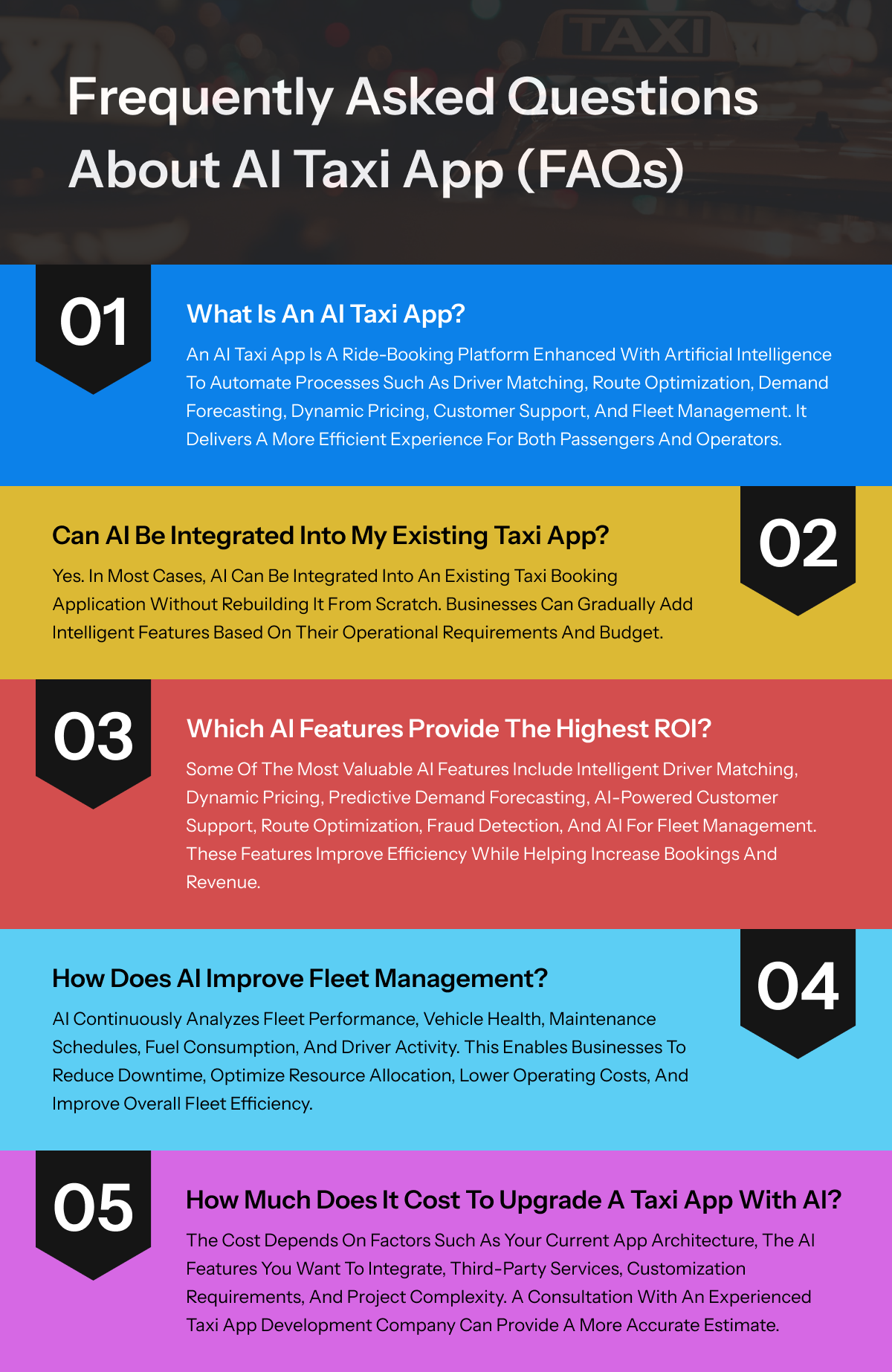
FAQs About AI Taxi App
Upgrading a taxi app with AI often raises questions about implementation, costs, features, and business benefits. To help you make an informed decision, we’ve answered some of the most common questions taxi business owners and fleet operators ask before integrating AI into their existing taxi booking app. These answers will give you a clearer understanding of how AI can enhance your operations, improve customer satisfaction, and drive long-term business growth.
Final Thoughts
Your taxi app may already be helping customers book rides, but in today’s competitive market, basic functionality is no longer enough. Passengers expect faster service, personalized experiences, transparent pricing, and seamless support, while businesses need smarter tools to improve efficiency and maximize profitability.
Integrating AI into your existing taxi booking app enables you to meet these expectations without rebuilding your entire platform. From intelligent driver matching and predictive analytics to AI-powered customer support and fleet management, the right AI features can transform the way your business operates.
Investing in AI today is not just about adopting new technology—it’s about creating a stronger foundation for sustainable growth, higher customer retention, and long-term success.

Ankit Patel is the Project Delivery Head at XongoLab Technologies LLP and PeppyOcean, leading mobile app development companies specializing in custom software & mobile app solutions. Passionate about technology and innovation, he enjoys writing about mobile & software development, business, and marketing. His articles have been featured on renowned publications, including YourStory, E27, Datafloq, JaxEnter, TechTarget, Adobe, DesignWebKit, InstantShift, Business Magazine, Simple Programmer, and many others.
You may also like
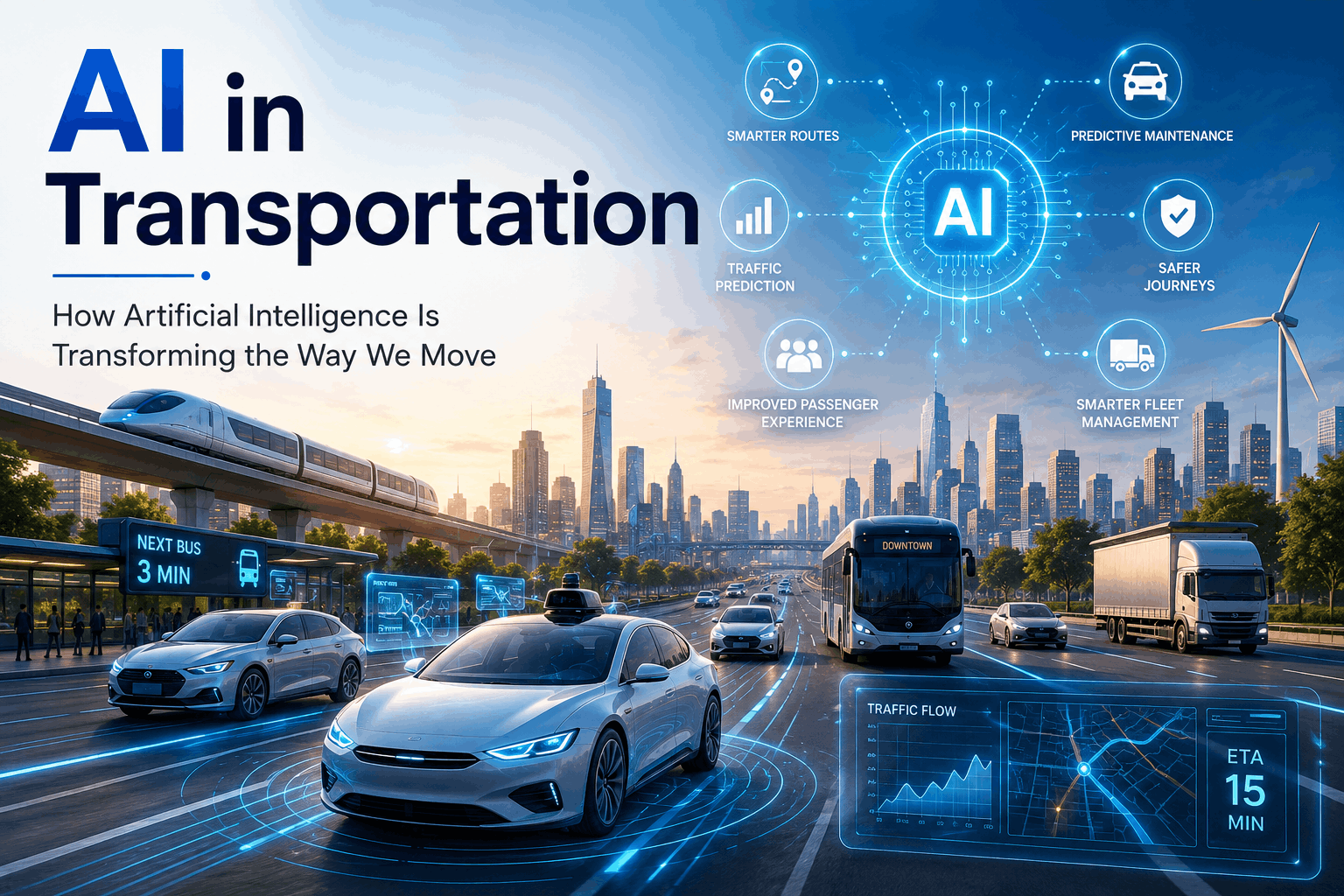
AI in Transportation: How Artificial Intelligence Is Transforming the Way We Move
-
Transportation has always evolved alongside technology. From steam-powered trains to electric vehicles and GPS navigation, every major innovation has changed how people and goods move from one place to another. Today, AI in transportation is becoming another major turning point. Artificial intelligence is helping transportation companies make faster decisions, understand changing travel patterns, improve fleet… Read More

How Courier App Development Improves Delivery Operations
-
A customer places an order and expects one thing: the package should arrive when promised. Behind that simple expectation, courier businesses have to coordinate orders, drivers, routes, payments, tracking, customer updates, and delivery schedules every day. As delivery volumes grow, managing these activities through spreadsheets, phone calls, or disconnected systems becomes difficult. A small delay… Read More
How AI Can Improve Your Food Delivery App with Intelligent Automation
-
The online food delivery industry has experienced tremendous growth over the past decade. Customers now expect more than just a platform to place food orders—they demand personalized recommendations, lightning-fast deliveries, real-time tracking, accurate ETAs, seamless customer support, and an overall hassle-free experience. As competition continues to grow, simply having a Food Delivery App is no… Read More
Recent Posts
 AI in Transportation: How Artificial Intelligence Is Transforming the Way We Move
 How Courier App Development Improves Delivery Operations
 How AI Can Improve Your Food Delivery App with Intelligent Automation
 How AI Can Upgrade Your Existing Taxi App to Increase Bookings and Revenue
 Build a Laundry App in 2026: Business Model, Features, Cost, Revenue & Challenges