
How Much Does It Cost To Build An App Like Citymapper?
-
Ankit Patel
- December 23, 2025
- 5 min read
Big cities are getting more crowded every year. Roads stay busy, public transport feels complex, and people are always short on time. Finding the fastest and most reliable route has become a daily struggle for millions of commuters and travelers. This challenge has created strong demand for smarter digital solutions in the travel navigation app market.
Citymapper gained popularity because it solved a real and growing problem. It began in the UK, where cities like London have dense and complicated transport networks. Over time, the app expanded across Europe, helping people move confidently through cities they did not know well. Its success in the European market proves how much users value accuracy, live updates, and simple journey planning in one place.
Today, users expect more than just maps. They want real-time arrival information, multiple transport choices, and routes that adjust instantly. Apps like Citymapper improve urban mobility by helping users choose buses, trains, cycling, walking, or combined routes based on live conditions. This change has turned smart transport apps into a daily necessity rather than a convenience.
As demand grows, more startups and businesses are looking to build similar platforms. But the first concern is always the budget. The cost of developing a travel app like Citymapper varies widely and depends on features, design quality, technology stack, and where the development team is located. Without clear insight, many ideas never move beyond planning.
Citymapper succeeded because it performs reliably in real situations. Millions of people depend on it to reach work on time, avoid delays, and move smoothly through busy cities. At that scale, the app becomes part of the city’s infrastructure, not just another piece of software. Creating that level of reliability requires advanced data handling, live transport integrations, and careful engineering.
This is where the real conversation begins. The investment behind navigation app development is shaped by what you build, how you build it, and how well it is designed to handle real-world pressure.
◉ What is the Citymapper App?
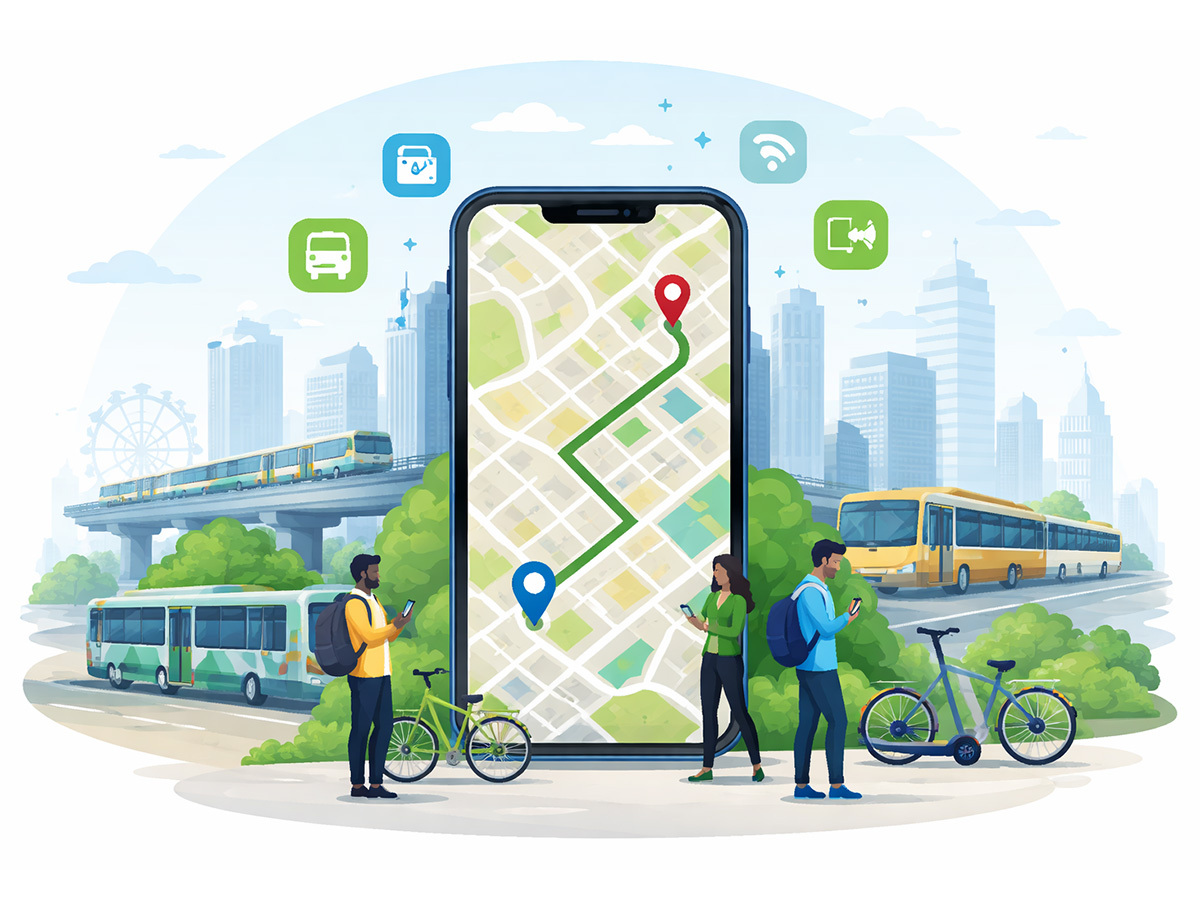
Citymapper is a smart travel app designed to help people move easily within cities. It brings together buses, trains, metro services, walking routes, cycling paths, and ride options into one platform. Users can plan routes, check arrival times, and receive service alerts in real time using a single app.
At its core, Citymapper is a Navigation app that focuses on urban travel. Unlike basic map apps, it is built specifically for public transport users who need accuracy, speed, and reliability during daily commutes or city exploration.
◉ Market Demand for Citymapper-Like Apps
Citymapper has already proven the demand for smart navigation, with the app serving over 50 million users across more than 100 cities worldwide, combining multiple transport modes into one platform that works for buses, trains, cycling, walking, and more.
The broader market for smart navigation apps is expanding rapidly. The global smart navigation apps market is projected to grow from around $1.62 billion in 2024 to about $5.4 billion by 2034, reflecting increasing reliance on real‑time route planning and travel guidance.
The global travel navigation app market was valued at $5.4 billion in 2024 and is expected to reach $15.1 billion by 2033, reflecting rising demand for real-time, multi-modal commuting solutions.
As commuters rely more on accurate, real-time route planning, the demand for smart Citymapper-style apps is rising, especially in Europe’s dense urban centers, creating significant opportunities for new solutions.
◉ Key Features You Need to Build an App like Citymapper
An app like Citymapper works because it removes confusion from city travel. Every feature exists to answer one question clearly: how do I get from here to there right now, without wasting time?
Instead of overwhelming users, the app focuses on showing the most relevant information at the right moment. Below are the essential features that make this possible.
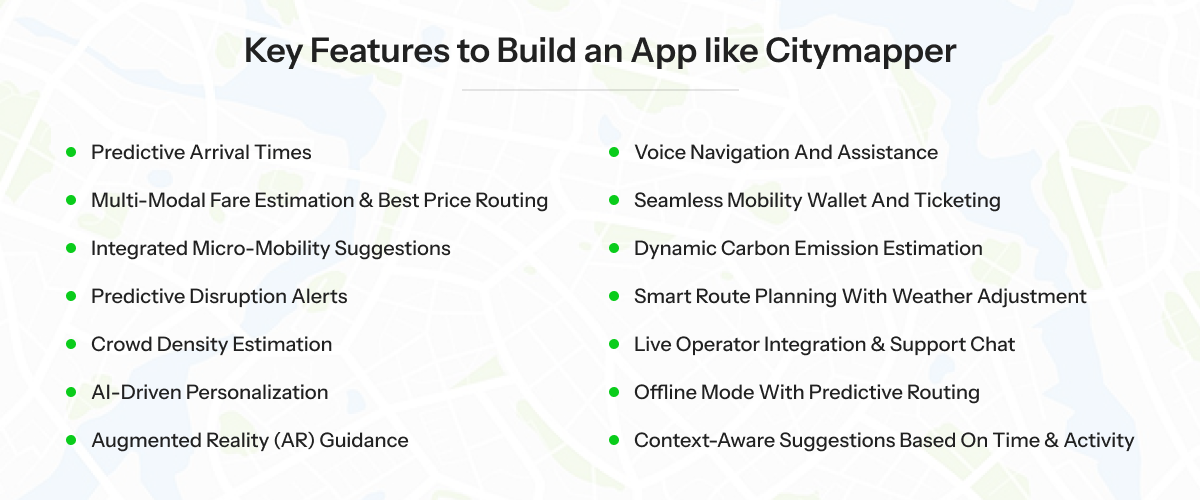
1. Predictive Arrival Times
Instead of just showing scheduled times, the app estimates actual arrival times using AI models that learn from historical data, live GPS feeds, and traffic patterns. This goes beyond classic real-time updates.
2. Multi-Modal Fare Estimation & Best Price Routing
Today’s users want clear cost comparisons. The app should show predicted fares across all modes in real time, including shared mobility and micro-mobility options.
3. Integrated Micro-Mobility Suggestions
E-scooters, dockless bikes, and shared e-bikes are now part of the urban travel ecosystem. The app should recommend these when they offer faster or cheaper routes.
4. Predictive Disruption Alerts
Instead of only notifying users once a delay happens, modern apps predict likely disruptions before users are impacted based on patterns and alerts from transport operators.
5. Crowd Density Estimation
By analyzing live data and historical trends, the app can indicate how crowded a vehicle or station is likely to be — useful for social distancing or comfort-based route selection.
6. AI-Driven Personalization
The app learns individual travel habits and starts suggesting routes before users even search — for example, daily commute alternatives when traffic spikes.
7. Augmented Reality (AR) Guidance
AR overlays on the phone camera can help users find the right exit, platform, or direction in complex stations and interchange zones.
8. Voice Navigation and Assistance
Voice prompts that speak directions aloud while walking or transferring make the experience safer and more hands-free.
9. Seamless Mobility Wallet and Ticketing
Embedding payments directly or integrating with local ticketing systems allows users to pay fares without leaving the app.
10. Dynamic Carbon Emission Estimation
Showing estimated CO₂ emissions per route appeals to eco-conscious users and aligns with global sustainability trends.
11. Smart Route Planning with Weather Adjustment
Suggesting alternate routes automatically when rain, heat, or severe weather is expected — all without user intervention.
12. Emergency & Safety Mode
Quick access buttons for nearby help, ambulance, police directions, and safe routes at night — built around personal safety.
13. Offline Mode with Predictive Routing
Downloading city maps and schedules locally, combined with predictive caching, so users get near-real guidance even with no connectivity.
14. Context-Aware Suggestions Based on Time & Activity
Recommendations change depending on morning commute, weekend travel, or night schedules automatically.
15. Live Operator Integration & Support Chat
Direct messaging with support or local transport operators for instant help, report issues, or get updated info during disruptions.

◉ Step-by-Step Process to Build an App Like Citymapper
Developing a Citymapper-style app isn’t just about writing code. It’s about understanding city travel, designing for real-world use, and delivering an experience people trust every day. Here’s how to approach it, step by step.
1. Research and Market Understanding
Before a single screen is designed, you need a clear picture of the city, the transport ecosystem, and your users.
- Study public transport networks, timetables, and mobility services.
- Identify pain points for commuters, tourists, and occasional travelers.
- Analyze competitors to see what works and where gaps exist in the market.
This step ensures your app solves real problems and stands out in the crowded urban mobility space.
2. Define Core Features and MVP
Not every feature needs to be in the first version. Start with a minimum viable product (MVP) that solves the core problem: helping users navigate a city efficiently. Focus on essentials like:
- Multi-modal journey planning
- Live transit updates
- Turn-by-turn navigation
- Favorite routes
You can plan advanced features like predictive routing, AR guidance, or integrated ticketing for later phases.
3. UI/UX Design
Design is not just about aesthetics; it’s about usability under real conditions. Users may be walking, cycling, or rushing through stations.
- Keep screens uncluttered.
- Highlight the most important actions first.
- Ensure maps, route suggestions, and alerts are visible at a glance.
A strong mobile app design builds trust and keeps users coming back.
4. Choose the Right Technology Stack
The app must process massive amounts of live data in real time. Key considerations:
- For Android – Kotlin or Java
- For iOS – Swift
- For Frontend – React, Java, Angular, CSS, HTML
- For Backend – Node.JS, Express.JS, Python, and APIs for live transport feeds
- Map & Navigation – Google Maps SDK / Mapbox, GPS integration, route optimization algorithms, offline map storage
- Payment – PayPal, Stripe, Braintree, EWallets
- For Server / Cloud – AWS, Google Cloud, or Azure
- Offline Map Storage – Ensures navigation works in underground or low-network areas
- Live Transport Feeds – Integrate local APIs (e.g., GTFS) for real-time arrivals and delays
- Push Notifications – Twilio, Push.io
- For Database – MongoDB, HBase, Postgres<
Choosing scalable technology upfront saves headaches later when the app grows to millions of users.
5. Development Phase
The actual coding starts here. Developing a travel app usually happens in sprints, gradually adding features and ensuring smooth functionality.
- Backend handles route computation, live updates, and user data.
- Frontend displays maps, notifications, and interactive elements.
- APIs integrate third-party transport data, payment systems, or mobility providers.
Regular reviews during development ensure the product matches design and functionality goals.
6. Testing and Quality Assurance
An app like Citymapper must be extremely reliable. Even minor errors in routing or timing can frustrate users.
- Test under real-world conditions in multiple cities.
- Check for GPS accuracy, map loading, and offline functionality.
- Simulate delays, service disruptions, and peak-hour usage.
Thorough QA ensures the app performs flawlessly when users need it most.
7. Launch and Early Feedback
Release the MVP in a controlled environment or select cities first. Early feedback is critical:
- Monitor app performance and user behavior.
- Collect feedback on route accuracy, interface usability, and notification relevance.
- Fix bugs quickly and plan updates based on actual usage patterns.
This approach reduces risk and ensures the product scales smoothly.
8. Continuous Updates and Scaling
City navigation changes constantly, so the app must evolve:
- Add new cities, transport modes, or advanced features.
- Update predictive models, route optimizations, and live alerts.
- Improve personalization as users’ travel patterns become clearer.
Continuous improvement ensures the app stays competitive in the growing travel navigation app market.
You May Also Like: Cost to Build a Route Planning App Like Komoot
◉ How Much Does It Cost to Build an App Like Citymapper?
There is no fixed budget to build an app like Citymapper. Costs vary depending on the features you include, the complexity of the app, the quality of UI/UX design, and the location of your development team.
To give you a rough estimate, developing an app like Citymapper typically ranges from $25,000 to $150,000 or more, depending on your specific requirements.
Here’s how the cost usually breaks down:
| App Types | Estimated Cost | Key Features |
| Basic Version | $25,000 – $40,000 | Multi-modal route planning, live transit updates, GPS navigation, saved/favorite routes |
| Mid-Level App | $40,000 – $80,000 | Offline maps, saved destinations, push notifications, personalized route suggestions |
| Advanced / Feature-Rich App | $80,000 – $150,000+ | Predictive routing, AR navigation, ticketing integration, CO₂ tracking, crowdsourced updates, multi-language support |
If you think this budget is too high, there’s another option. You can go with a readymade Citymapper clone, which is available at cost-effective rates and can be launched in just a few days, helping you enter the market faster without compromising on core functionality.
◉ How Citymapper-like Apps Generate Revenue
You might think apps like Citymapper are completely free, and they are for users. But behind the scenes, they make money in ways that keep the app running and improving.
1. Paid Subscriptions
Offer premium features like offline maps, predictive journey suggestions, or an ad-free experience. Daily commuters often find this worth a small monthly fee.
2. Ticketing & Mobility Commissions
Let users buy train, metro, or bike-share tickets directly in the app. You earn a commission on every purchase.
3. Partnerships with Transport Providers
Collaborate with local transit companies or mobility brands for integration deals or featured placement. These are usually revenue-share or fixed contracts.
4. Contextual Ads & Local Offers
Show useful, location-based offers like nearby cafes, ride-hailing discounts, or luggage storage deals. Ads are relevant and helpful, not annoying.
5. Data & Analytics Services
Provide anonymized travel data to city planners or transport authorities. They pay for insights on traffic patterns, peak hours, or route optimization.
◉ Why Choose PeppyOcean to Develop an App Like Citymapper
Building an app like Citymapper is complex. It’s not just about maps or routes—it’s about live data, seamless multi-modal travel options, predictive routing, and a smooth user experience. That’s why choosing the right development partner matters.
At PeppyOcean, we specialize in urban mobility and travel apps. Here’s why working with us makes sense:
- Proven Experience: We have built navigation and travel apps for cities across Europe and the UK, handling complex public transport networks and multi-modal integration.
- End-to-End Development: From ideation, UI/UX design, backend infrastructure, to testing and deployment, we cover everything. You don’t need multiple vendors or teams.
- Scalable & Future-Ready Solutions: We focus on building apps that can grow—adding new cities, predictive features, or integrations without a complete rewrite.
- User-Centric Design: Our mobile app design philosophy keeps real commuters in mind. Maps are clear, navigation is simple, and the app works under real-world conditions like underground stations or crowded streets.
- Support & Maintenance: Launching the app is just the start. We provide continuous support, updates, and improvements to keep your app reliable and competitive in the fast-growing travel navigation app market.
With PeppyOcean by your side, you get more than a development team; you get a partner who understands urban mobility, the challenges of smart city travel, and how to turn complex transport data into a simple, reliable app users love.
◉ Conclusion
Cities are complex, and moving through them shouldn’t be. A travel app like Citymapper turns the chaos of public transport, walking, cycling, and shared rides into a smooth, reliable experience that users can count on every day. It’s not just about technology—it’s about understanding real people, their routines, and the challenges they face.
When built thoughtfully, a Citymapper-style app doesn’t just help people reach their destinations faster; it transforms the way they experience the city, earning trust, loyalty, and daily engagement. Ultimately, success comes from simplicity, accuracy, and a deep focus on the people who rely on it.

Ankit Patel is the Project Delivery Head at XongoLab Technologies LLP and PeppyOcean, leading mobile app development companies specializing in custom software & mobile app solutions. Passionate about technology and innovation, he enjoys writing about mobile & software development, business, and marketing. His articles have been featured on renowned publications, including YourStory, E27, Datafloq, JaxEnter, TechTarget, Adobe, DesignWebKit, InstantShift, Business Magazine, Simple Programmer, and many others.
You may also like

How to Choose an On Demand App Development Company for Your AI-Powered Business
-
Businesses across industries are moving toward on-demand services as customers increasingly expect convenience, speed, and personalized experiences. From food delivery and transportation to healthcare, home services, logistics, and grocery delivery, on-demand platforms are changing how businesses connect with their customers. The market is also becoming increasingly intelligent. The global AI in transportation market is estimated… Read More

AI in Transportation: How Artificial Intelligence Is Transforming the Way We Move
-
Transportation has always evolved alongside technology. From steam-powered trains to electric vehicles and GPS navigation, every major innovation has changed how people and goods move from one place to another. Today, AI in transportation is becoming another major turning point. Artificial intelligence is helping transportation companies make faster decisions, understand changing travel patterns, improve fleet… Read More
How Courier App Development Improves Delivery Operations
-
A customer places an order and expects one thing: the package should arrive when promised. Behind that simple expectation, courier businesses have to coordinate orders, drivers, routes, payments, tracking, customer updates, and delivery schedules every day. As delivery volumes grow, managing these activities through spreadsheets, phone calls, or disconnected systems becomes difficult. A small delay… Read More
Recent Posts
 How to Choose an On Demand App Development Company for Your AI-Powered Business
 AI in Transportation: How Artificial Intelligence Is Transforming the Way We Move
 How Courier App Development Improves Delivery Operations
 How AI Can Improve Your Food Delivery App with Intelligent Automation
 How AI Can Upgrade Your Existing Taxi App to Increase Bookings and Revenue