
How Much Does It Cost to Build a Logistics App Like Aramex?

-
Ankit Patel
- December 04, 2025
- 6 min read
The logistics and transportation industry in the Middle East—particularly in the UAE and Saudi Arabia—is undergoing a massive digital transformation. From small courier services to full-scale regional delivery networks, companies are adopting technology to streamline operations, increase efficiency, and deliver superior customer experiences.
The transportation business today demands real-time visibility, digital payments, and smart route optimization. As a result, companies are rapidly shifting from manual processes to smart, automated apps.
One of the most recognized success stories in this sector is Aramex, whose innovative use of technology has positioned it as a logistics powerhouse in the region.
Building a modern logistics app has now become a top priority for businesses across the UAE, Saudi Arabia, and the Middle East. With the rapid expansion of the logistics market, companies are seeking digital solutions that function as smoothly and efficiently as Aramex.
If you’re considering entering this space and wondering about the cost of building an app like Aramex, this guide covers everything you need to know.
◉ The Middle East Logistics Boom
The logistics market in the Middle East is booming, driven by e-commerce growth, global trade expansion, and increased consumer demand for fast and reliable delivery. Countries like the UAE and Saudi Arabia are investing heavily in digital infrastructure and smart technologies to strengthen their positions as regional logistics hubs.
Experts estimate that by 2030, Saudi Arabia alone will invest over $147 billion in developing road, rail, air, and sea networks—creating massive opportunities for digital logistics platforms. Businesses that embrace technology early will be well-positioned to lead the market.
◉ Why Logistics Companies Need Mobile Apps
Modern logistics is no longer just about transporting parcels. Today’s businesses must track shipments in real-time, optimize delivery routes, manage fleets, and maintain constant communication with customers. A mobile or web app becomes the centralized digital hub that connects all these processes.
Mobile apps significantly improve operational efficiency, reduce human error, boost transparency, and support faster business scaling. Whether you’re a startup or an established logistics operator, investing in a robust logistics app is essential—not optional.

◉ The Role of Technology in the Transportation Business
In the transportation industry, speed, accuracy, and visibility are everything. Customers want instant updates on their shipment status, delivery time, and available delivery options. Mobile apps powered by real-time GPS tracking and automated notifications meet these expectations while also reducing operational costs.
Additionally, apps allow logistics providers to manage fleets, warehouses, and drivers simultaneously—ensuring an uninterrupted supply chain.
◉ Trends in the Logistics and Transportation Industry
The logistics industry in the Middle East is evolving rapidly. Key trends shaping the future include:
- AI in logistics – predictive analytics, smart routing, automated dispatch.
- Real-time GPS tracking – complete shipment visibility for customers and managers.
- Automated notifications – instant alerts via app, SMS, and email.
- Digital payment integration – faster, secure, and more convenient transactions.
These technologies help logistics providers offer premium services and reduce operational overhead.
◉ Why Build a Logistics App Like Aramex?
If you’re aiming for logistics app development similar to Aramex, your app should prioritize reliability, speed, and a user-friendly experience. Essential capabilities include:
- Live shipment tracking
- AI-driven route optimization
- Driver and fleet management
- In-app payments and billing
- Push notifications and alerts
For companies exploring transportation app development in the Middle East, focusing on scalability is essential. A successful logistics app should handle multiple shipments, fleets, warehouses, and even cross-border deliveries as your business grows.
◉ Must-Have Features to Include in a Logistics App
To compete with top logistics players like Aramex, your app must combine efficiency, transparency, and convenience. The right features ensure faster deliveries, happier customers, and smoother operations. Here’s what every modern logistics app should include:
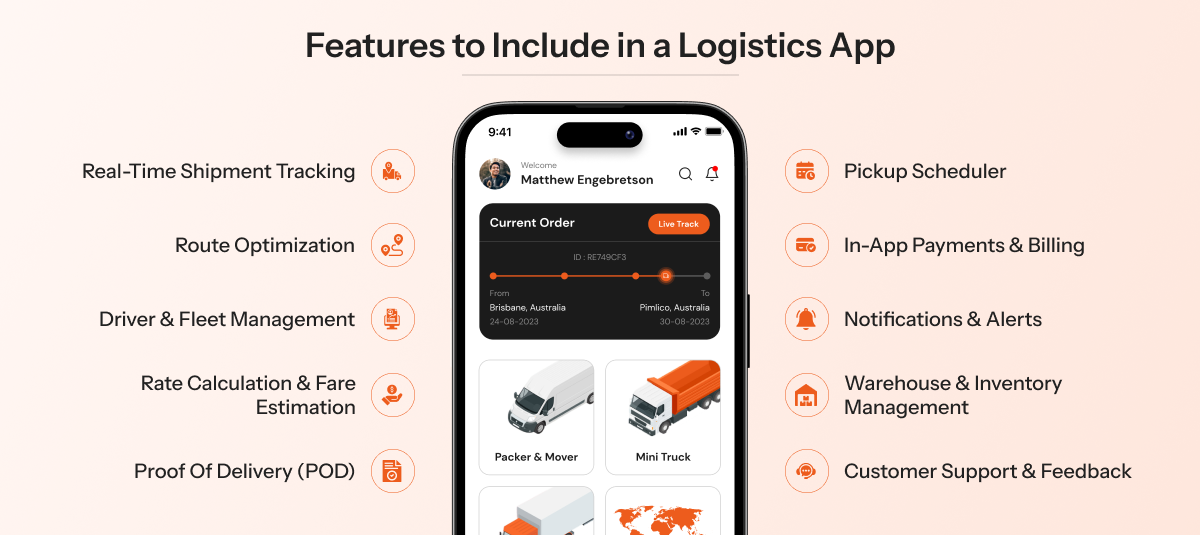
1. Real-Time Shipment Tracking
Customers today expect complete transparency. Real-time GPS tracking allows them to see exactly where their parcel is, receive accurate delivery estimates, and get instant updates on delays or changes. This builds trust and improves satisfaction.
2. Route Optimization
Efficient route planning is crucial for reducing delivery times and operational costs. AI-powered route optimization calculates the fastest and most cost-effective paths for your fleet, considering traffic, weather, and delivery urgency.
3. Driver & Fleet Management
Centralized dashboards for drivers and fleet managers help monitor vehicle locations, driver availability, and performance. Automated assignments and maintenance alerts ensure smooth operations and minimal downtime.
4. Rate Calculation & Fare Estimation
Customers need transparency when it comes to pricing. Dynamic rate calculation and fare estimation based on weight, distance, and delivery urgency empower users to make informed decisions while reducing disputes and confusion.
5. Pickup Scheduler
A flexible pickup scheduler allows customers to book parcel pickups at convenient times. This feature not only improves user experience but also optimizes driver routes and delivery planning for the company.
6. Proof of Delivery (POD)
Digital proof of delivery, including signatures, photos, or QR code verification, ensures accountability and reduces disputes. POD also helps maintain accurate records for both customers and logistics managers.
7. In-App Payments & Billing
Secure and seamless payment integration, including credit/debit cards, digital wallets, and cash-on-delivery tracking, simplifies transactions and accelerates cash flow. Automated invoicing and billing enhance operational efficiency.
8. Notifications & Alerts
Push notifications, SMS, and email alerts keep customers informed about shipment status, delivery confirmations, and promotions. Internal alerts about route changes, delays, or maintenance improve responsiveness and operational control.
9. Warehouse & Inventory Management
Real-time inventory tracking across multiple warehouses ensures smooth supply chain operations. This feature helps prevent stock-outs, overstocking, and operational bottlenecks, keeping deliveries on schedule.
10. Analytics & Reporting
Data-driven insights on delivery performance, fleet efficiency, and customer behavior allow businesses to continuously optimize operations, make informed decisions, and stay ahead of competitors.
11. Customer Support & Feedback
Integrated in-app support and feedback channels build trust, resolve issues promptly, and enhance customer loyalty, making your app stand out in a competitive market.
◉ How Much Does it Cost to Build a Logistics App Like Aramex?
The cost of building a logistics and transportation app like Aramex depends on several factors, such as app complexity, platform (Android/iOS), features, UI/UX, and the technology stack. While there’s no fixed price, understanding these cost drivers helps you plan more effectively.
Generally, developing an app like Aramex costs around $15,000 to $25,000 for a simple app, including core features like shipment tracking, notifications, and digital payments.
If you plan to build a fully advanced logistics app with features such as AI-based route optimization, multi-warehouse management, predictive analytics, and digital proof of delivery, the overall cost can exceed $60,000.
Here’s a quick breakdown:
| App Types | Estimated Cost |
| Simple App | $15,000 – $25,000 |
| Mid-Complex App | $25,000 – $60,000 |
| Advanced / Aramex-Level App | $60,000 – $100,000+ |
Key Insight:
Investing in a powerful logistics app is a long-term strategy. A well-built logistics platform improves operational efficiency, reduces manual errors, enhances customer trust, and helps you compete with top logistics players in the Middle East.

◉ How PeppyOcean Helps You Build a Logistics & Transportation App Like Aramex
Partnering with the right logistics app development company can make the difference between a good app and a great one. At PeppyOcean, we specialize in logistics and transportation app development tailored for the UAE, Saudi Arabia, and Middle East markets. Here’s how we help:
- Custom Solutions: We build apps customized to your business needs, from courier delivery to enterprise fleet management.
- Scalable Architecture: Our apps are designed to handle growing delivery volumes and multiple regional operations.
- AI & Automation Integration: We incorporate AI for smart route optimization, predictive delivery, and operational efficiency.
- Seamless UX/UI: Simple and intuitive designs ensure both drivers and customers have a smooth experience.
- End-to-End Support: From concept to deployment, maintenance, and updates, we ensure your logistics app evolves with your business.
With our expertise, you can build a logistics app like Aramex that is reliable, scalable, and designed for long-term growth.
◉ Final Thoughts
The logistics and transportation industry in the Middle East is evolving rapidly, and businesses in the UAE and Saudi Arabia have a tremendous opportunity to lead this digital shift. A well-designed logistics app can reduce operational costs, increase efficiency, and deliver a superior customer experience.
While the cost to build an app like Aramex varies, the long-term advantages are substantial. By partnering with an experienced logistics app development company, you can bring your vision to life and build a transportation app that stands alongside the region’s leading logistics platforms.
The future of logistics is digital—and the best time to innovate is now.
◉ FAQs
1. How long does it take to develop a logistics app like Aramex?
A simple logistics app can take 8-12 weeks, while a mid-complex or advanced app with AI, multi-warehouse management, and automation can take 4-6 months, depending on features, app complexity, and integrations.
2. Can a logistics app handle multiple drivers, warehouses, and countries?
Yes. With the right architecture, your logistics app can support multi-fleet operations, cross-border shipping, hub-to-hub routing, and warehouse networks.
3. Is it possible to integrate digital payments and COD tracking?
Absolutely. Logistics apps typically support credit/debit cards, Apple Pay, Google Pay, bank transfers, and COD reconciliation for smooth financial operations.
4. Can you build an Aramex-type app for startups or small delivery companies?
Yes! Scaled-down versions can be developed starting from core essential modules, giving small companies access to enterprise-grade technology at an affordable cost.

Ankit Patel is the Project Delivery Head at XongoLab Technologies LLP and PeppyOcean, leading mobile app development companies specializing in custom software & mobile app solutions. Passionate about technology and innovation, he enjoys writing about mobile & software development, business, and marketing. His articles have been featured on renowned publications, including YourStory, E27, Datafloq, JaxEnter, TechTarget, Adobe, DesignWebKit, InstantShift, Business Magazine, Simple Programmer, and many others.
You may also like

How to Choose an On Demand App Development Company for Your AI-Powered Business
-
Businesses across industries are moving toward on-demand services as customers increasingly expect convenience, speed, and personalized experiences. From food delivery and transportation to healthcare, home services, logistics, and grocery delivery, on-demand platforms are changing how businesses connect with their customers. The market is also becoming increasingly intelligent. The global AI in transportation market is estimated… Read More

AI in Transportation: How Artificial Intelligence Is Transforming the Way We Move
-
Transportation has always evolved alongside technology. From steam-powered trains to electric vehicles and GPS navigation, every major innovation has changed how people and goods move from one place to another. Today, AI in transportation is becoming another major turning point. Artificial intelligence is helping transportation companies make faster decisions, understand changing travel patterns, improve fleet… Read More
How Courier App Development Improves Delivery Operations
-
A customer places an order and expects one thing: the package should arrive when promised. Behind that simple expectation, courier businesses have to coordinate orders, drivers, routes, payments, tracking, customer updates, and delivery schedules every day. As delivery volumes grow, managing these activities through spreadsheets, phone calls, or disconnected systems becomes difficult. A small delay… Read More
Recent Posts
 How to Choose an On Demand App Development Company for Your AI-Powered Business
 AI in Transportation: How Artificial Intelligence Is Transforming the Way We Move
 How Courier App Development Improves Delivery Operations
 How AI Can Improve Your Food Delivery App with Intelligent Automation
 How AI Can Upgrade Your Existing Taxi App to Increase Bookings and Revenue